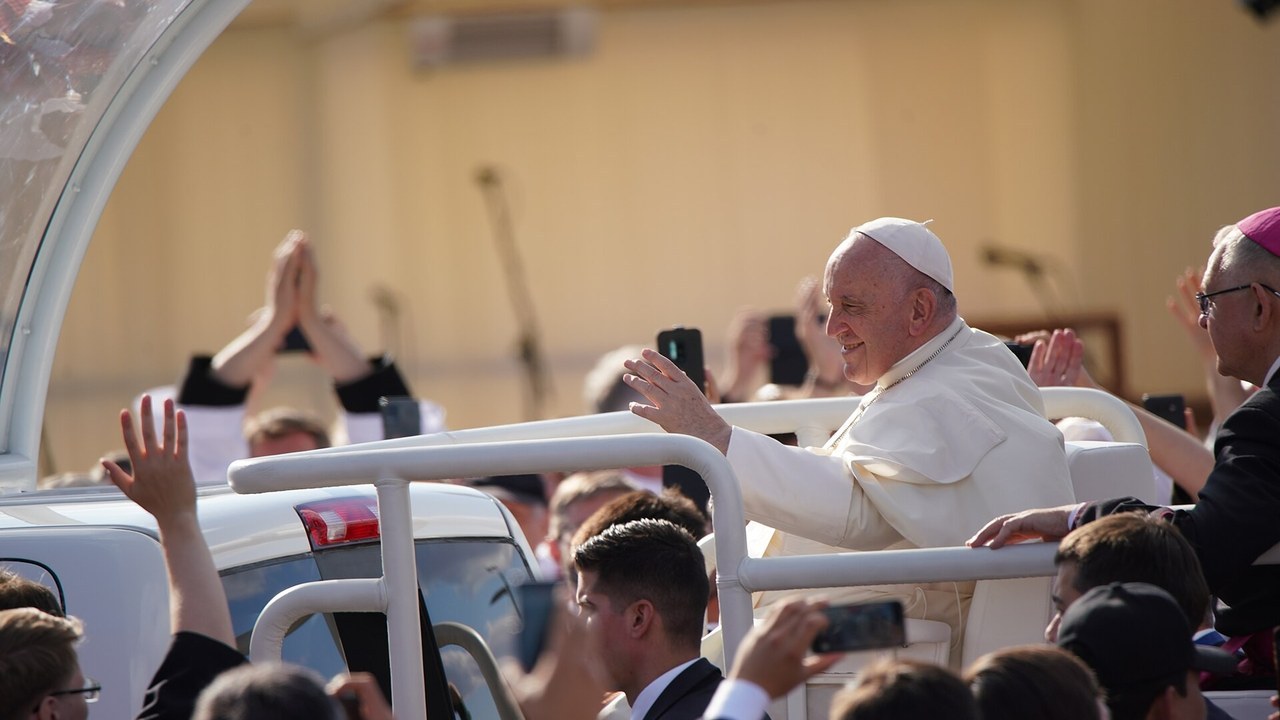
Pope Francis wrote that he saw the devil three times — twice in Buenos Aires and once as pope — and that he once saw the entrance to hell. The revelations come from his private diary, kept for 32 years and published on Tuesday as “The Private Diary of Pope Francis.”
The 160-page book was compiled by Cardinal Víctor Manuel Fernández, one of Francis's closest aides and the Vatican's doctrinal chief. It went on sale in five languages in 94 countries. Francis gave Fernández permission to publish before he died, showing him a box holding “three documents and a planner” and saying, “From this, you will all see.”
Three Encounters With the Devil
Francis wrote that the devil made himself present to him on three occasions. The first came from a car window in Buenos Aires, as he returned home; the second in the choir loft of a Carmelite chapel during Mass. Of the devil's eyes he wrote that they were menacing and seductive — in one entry, “eyes of fire.” In his final entry, dated August 18, 2024, he wrote: “I can't forget his eyes the first two times — from the car when I was returning to the house, and in the choir loft during Mass.”
The third came after his troubled 2018 visit to Chile, overshadowed by the clerical sexual abuse scandal. Days after returning to Rome, Francis wrote, he was in a meeting when he saw the devil again and heard his voice saying: “Now I've gotten everything I wanted.” He added: “Just as I can't forget his eyes from the previous two, in this case, I can't forget the powerful raspiness of his voice.”
The diary also records a vision of hell. On June 7, 2018, as the Chile crisis deepened, Francis wrote that he saw “the entrance to hell” — “pagan seduction in full force” — and that he peeked in, was terrified, and grabbed the rosary as a weapon.
A Two-Year Crisis Over Power
The book's other revelation is a spiritual crisis Francis suffered in 2021 and 2022 — a temptation he calls a curiosity about exercising power. On December 30, 2022, he wrote that he refused to treat “others like puppets.”
His answer was humility, carried to a point that frustrated even his allies. Fernández recounts a bishop asking Francis, in his presence, why he had not fired a Vatican official who spoke badly of him in public. After a long silence, Francis said he felt God did not want him to become a puppeteer who uses and manipulates people — so he let the man stay. He fought the pull of power by avoiding every symbol of papal majesty: a Vatican guesthouse, plain black shoes.
The diary is also a record of exhaustion: Francis rarely took a day off, never holidayed outside the Vatican, and in 2019 called himself “feeling exhausted, almost without spiritual support.” He died on Easter Monday, April 21, 2025, at 88, after weeks in hospital with double pneumonia.
What He Wrote About His Successor — And His Critics
The diary gives Francis's verdict on his successor: of Cardinal Robert Prevost — now Pope Leo XIV — he wrote that Prevost was “a great pastor, a generous missionary, and an irreproachable man.” He was generous to his critics too: Cardinal Robert Sarah had “a refined spiritual sensitivity,” and Cardinal Gerhard Müller “seems aggressive but he's a good man.”
On the abuse crisis, the diary is unsparing about his own failures. Of Chile in 2018 he wrote: “Devastated because of the situation in Chile and the dialogue with the journalists on the airplane. I fell off the cot then.” “It was hard for me to admit what happened in Chile; I didn't think it was so serious.” He later apologised and summoned all of Chile's bishops to Rome, where they offered their resignations en masse.
How Rare Is a Published Papal Diary?
Very rare — which is why this book is news beyond the devil passages. Some popes order their personal papers destroyed. The diaries of John XXIII were published after his death as “Journal of a Soul,” and some of John Paul II's papers were published too — but a pope's private diary reaching print with the reigning pope's approval is almost unheard of. Pope Leo XIV agreed to let Fernández review the manuscript.
The diary runs from December 20, 1992 — the year Jorge Mario Bergoglio became auxiliary bishop of Buenos Aires — to August 18, 2024: 86 pages written in Argentina, 55 while he was pope. Some entries are in a private code that Fernández says “we cannot and should not decipher,” and he left out private matters concerning living people.
THE STORY SO FAR
December 20, 1992 — Jorge Mario Bergoglio, newly auxiliary bishop of Buenos Aires, begins keeping a diary in a black-covered planner; the first two encounters with the devil follow in the late 1990s.
March 13, 2013 — Bergoglio is elected pope and takes the name Francis. The diary continues through his 12-year pontificate.
January–June 2018 — After the Chile abuse crisis, Francis records the third encounter with the devil and, on June 7, his vision of “the entrance to hell.”
2021–2022 — Francis undergoes a two-year spiritual crisis over the temptation of power, ending with his December 30, 2022 entry refusing to treat “others like puppets.”
August 18, 2024 — Francis writes his final diary entry, looking back on the three encounters with the devil.
April 21, 2025 — Francis dies on Easter Monday at 88. Before his death he shows Cardinal Fernández the diary and tells him it can be published.
October 5, 2026 — The Vatican announces the book will be released worldwide on November 24, in five languages and 94 countries. On the day, CNN, The Times, the National Catholic Reporter and OSV News publish the revelations within hours.
WHAT HAPPENS NEXT
The book is on sale now, and the reading has only begun. Theologians and historians will spend months on the 141 pages of diary inside the 160-page book. It does not settle the debates about Francis's papacy, but it shows, in his own handwriting, what they cost him.