One hundred and sixty-three years ago today, Abraham Lincoln stood up at the dedication of the Soldiers' National Cemetery in Gettysburg, Pennsylvania, and spoke for about two minutes. The speech was 272 words long. It is now regarded as one of the greatest speeches in American history — and it is also surrounded by one of the most repeated stories in American history, a story about how it was written that is simply not true.
The famous version goes like this: Lincoln scribbled the Gettysburg Address on the back of an envelope on the train to Gettysburg, dashed off in a hurry on the way to the ceremony. It is a wonderful story. It is also a myth, and the paper itself is the proof. The Library of Congress holds two of the five known handwritten copies of the Address, given by Lincoln to his two private secretaries, John Nicolay and John Hay. The earliest of them, the Nicolay copy, has its first page written on White House — then Executive Mansion — stationery. That is the paper of a man drafting at his desk in Washington, not scribbling on a train. Only the second page, on different paper, appears to have been rewritten in Gettysburg itself, on November 19, while Lincoln was staying at the home of Judge David Wills.
The day itself was nothing like the legend either. Lincoln was not even the main speaker. That honour belonged to Edward Everett, the celebrated orator and former governor of Massachusetts, who spoke for roughly two hours — more than 13,000 words — before Lincoln rose. Everett's speech is all but forgotten. Lincoln's, at barely a tenth of its length, is studied around the world. The contrast was obvious even the next day: on November 20, Everett wrote to Lincoln that he wished he could flatter himself that he had come 'as near to the central idea of the occasion, in two hours, as you did in two minutes.'
I should be glad, if I could flatter myself that I came as near to the central idea of the occasion, in two hours, as you did in two minutes. — Edward Everett to Abraham Lincoln, November 20, 1863
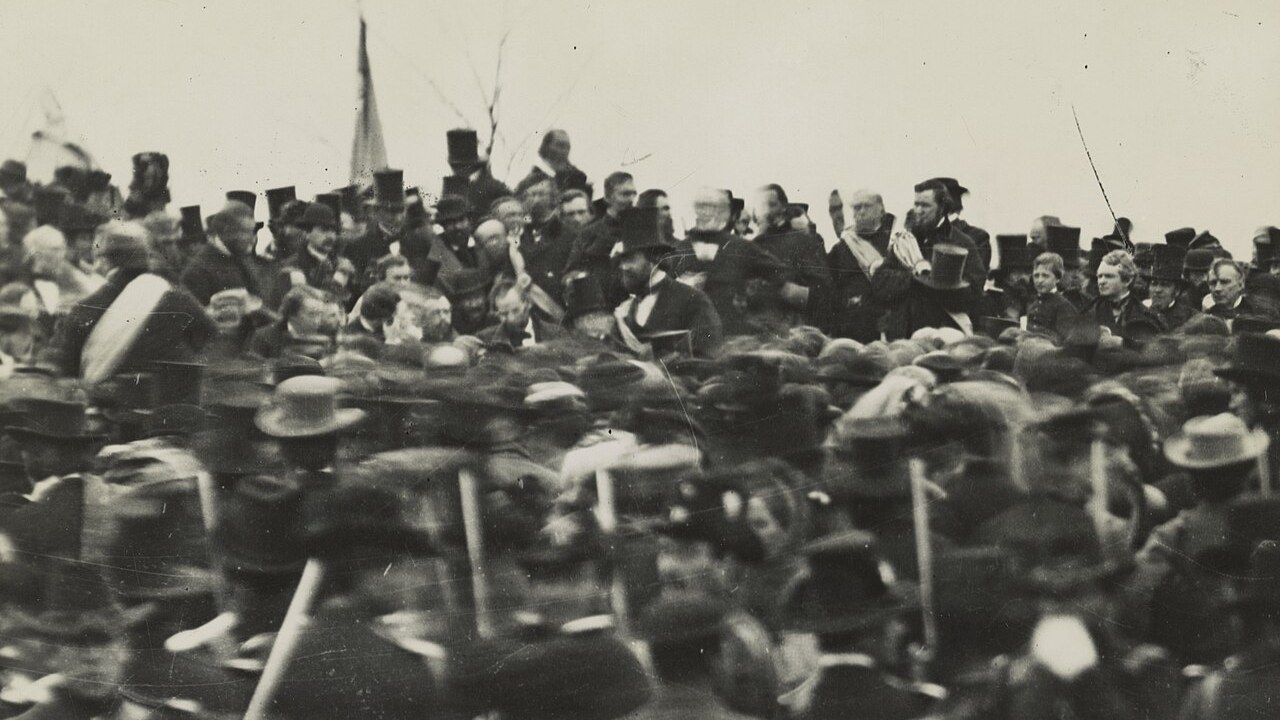
There is no photograph of Lincoln giving the speech, and there never was one. The famous photograph from that day — the one used with this story — shows the crowd at the dedication, hours before Lincoln spoke. Lincoln is in it, bareheaded among the hats near the centre of the platform, but he is easy to miss, and for 55 years nobody noticed him there at all. It was not until 1952 that National Archives archivist Josephine Cobb, enlarging the damaged glass plate negative, recognised the president in the crowd. The photograph had lain unidentified since the 1870s. The speech it captures the day of lasted two minutes; the photograph took nearly ninety years to be understood.
The occasion was a grim one. The Battle of Gettysburg had been fought four and a half months earlier, on July 1 to 3, 1863, and it had cost more than 50,000 casualties — the bloodiest battle ever fought on American soil, and the turning point of the Civil War. Pennsylvania's governor had ordered a national cemetery built for the Union dead, and November 19 was its dedication. Lincoln arrived by train the night before and stayed at the Wills house on the town square. The ground was still muddy from days of rain, and the cemetery was not even finished. He spoke in the afternoon, and then he sat down. The war itself went on for another year and a half, until the Confederacy surrendered on April 9, 1865. Five days later, on April 14, John Wilkes Booth shot Lincoln at Ford's Theatre.
THE FIVE COPIES
Lincoln wrote the Address out by hand five times, and each copy is slightly different — the word count varies a little depending on which one you count, which is why you will see 271, 272 or 273 words quoted. The Library of Congress holds two: the Nicolay copy, the earliest draft, and the Hay copy, probably made shortly after Lincoln returned to Washington. The Everett copy, written for the orator who spoke before him, is at the Illinois State Historical Library in Springfield. The Bancroft copy, requested by the historian George Bancroft, is at Cornell University. And the Bliss copy — made for Colonel Alexander Bliss, Bancroft's stepson — is the most frequently reproduced of all: it is the last copy Lincoln wrote, the only one he signed and dated, and it hangs today in the Lincoln Room of the White House.
THE STORY SO FAR
July 1 to 3, 1863: the Battle of Gettysburg is fought in and around the Pennsylvania town, with more than 50,000 casualties; it ends the Confederacy's invasion of the North. Autumn 1863: Pennsylvania Governor Andrew Curtin orders a Soldiers' National Cemetery built on the battlefield, and local attorney David Wills arranges the dedication for November 19, inviting Edward Everett as the main speaker and Lincoln to offer 'a few appropriate remarks.' November 18, 1863: Lincoln arrives by train and stays overnight at the Wills house. November 19, 1863: Everett speaks for about two hours; Lincoln follows with 272 words in about two minutes. November 20, 1863: Everett writes his letter of admiration to Lincoln. 1952: archivist Josephine Cobb identifies Lincoln in the dedication-day photograph, 55 years after the plate was filed away unidentified. November 19, 2026: the 163rd anniversary, marked as ever by the annual Dedication Day ceremony at the Soldiers' National Cemetery in Gettysburg National Military Park.
WHAT HAPPENS NEXT
The anniversary is marked every year at Gettysburg itself, where the Dedication Day ceremony is held at the Soldiers' National Cemetery on November 19. The two earliest drafts — the Nicolay and Hay copies — remain at the Library of Congress, where they are among the most consulted documents in the collection, and the Bliss copy remains on display in the Lincoln Room of the White House. The speech itself, all 272 words of it, is in the public domain, which is why it is quoted everywhere from schoolrooms to the 'I Have a Dream' speech, where Martin Luther King Jr. echoed its opening in August 1963 — almost exactly a century after Lincoln spoke. The envelope story will no doubt keep being repeated. It is a better story than the truth. But the truth is in the paper, and the paper is on White House stationery.