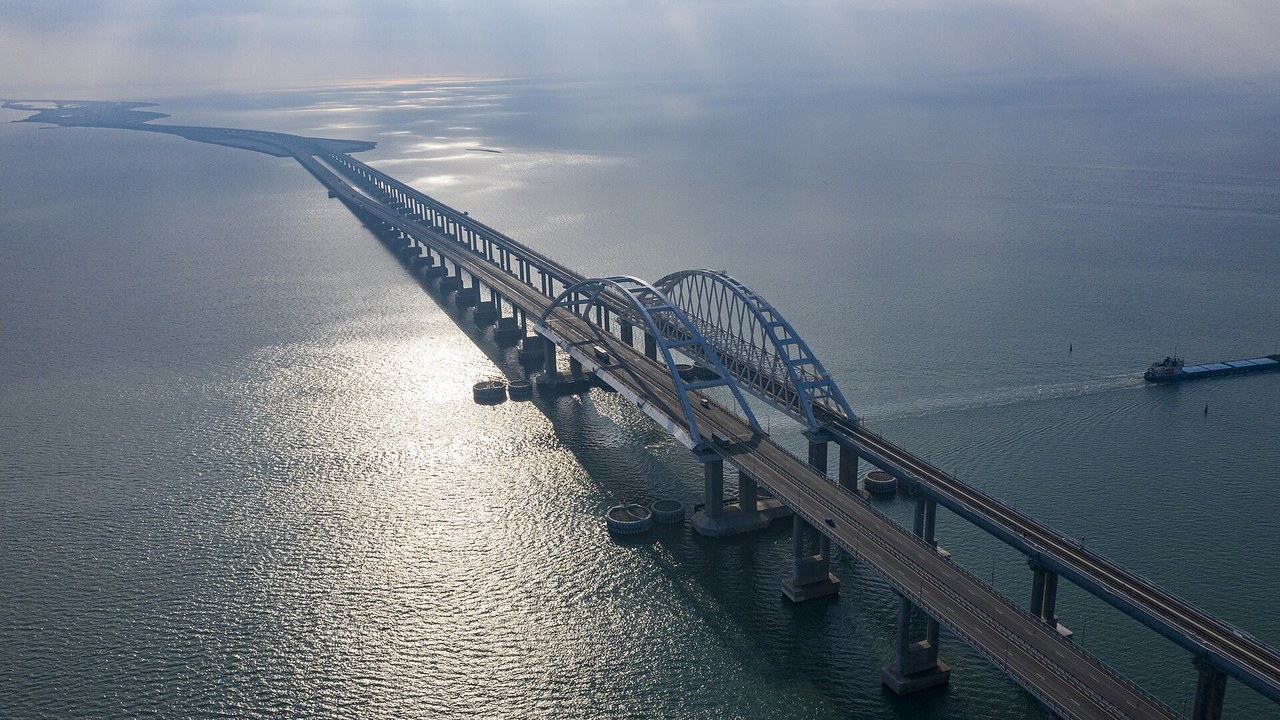
A video went viral on November 17, 2026, claiming to show the Kerch Bridge — the 19-kilometre road-and-rail crossing between Russia and occupied Crimea — collapsing after a Ukrainian attack. It carried the logo of 'UNN' and a caption saying road and rail traffic had stopped and debris had blocked the shipping channel. The clip spread fast. The video is fake. It was made with AI — and Google's own watermark is buried inside it.
That does not mean nothing happened. Ukraine really did strike the bridge on November 16 and 17, and the attack really did bring down the road section's steel arch and the roadway beneath it into the Kerch Strait. The real event and the fake video arrived on the same day, which is exactly why the clip spread so fast: it looked like proof of something true. This article separates the two — the fake clip, the real attack, and the five checks that tell them apart.
THE KEY NUMBERS
19 kilometres (12 miles): the length of the Kerch Bridge, Europe's longest crossing, built for 40,000 cars a day.
227 metres: the length of the steel road arch that collapsed into the strait — a structure weighing more than 5,000 tonnes.
$3.7 billion: the cost of the bridge, according to Russian state media — a signature project for Vladimir Putin after Russia annexed Crimea in 2014.
November 16-17, 2026: the two nights of Ukrainian drone and missile strikes that hit the bridge. The first damaged the road arch; the second brought it down.
2 people: the number Russian-installed Crimean governor Sergei Aksyonov said were killed in the attack in the region. That figure has not been independently verified.
99% and 99.8%: the AI scores two detectors gave a frame of the viral video — Sightengine said 99% likely AI, Hive Moderation said 99.8% likely AI-generated or deepfake content.
1 track: the railway service that resumed on the bridge on November 17, hours after traffic was suspended. The road section is still out of action — no vehicle can cross it.
HOW THE FAKE VIDEO WAS CAUGHT
The clip was posted on November 17 by an Instagram account called @unn.media, under a Ukrainian caption claiming the occupying authorities had confirmed traffic was halted and debris had blocked the channel to the Sea of Azov. The video itself carried a 'UNN' logo — the acronym of the real Ukrainian National News agency. But the real agency has no Instagram account, and the account that posted the video was not it.
Fact-checkers at Lead Stories tested a high-quality frame from the video with three separate AI-detection tools, and all three came back the same way. Sightengine put the odds of AI at 99%. Hive Moderation said the image was 99.8% likely to contain AI-generated or deepfake content. And Google's SynthID found an embedded invisible watermark in the image saying it 'was made or edited with Google AI'. The original post even carried an AI label of its own — the platform had already flagged what it was.
The account behind it did not hold up either. Its bio linked to a website that said 'UNN' stood for 'United News Network' and claimed to be a media holding operating from Singapore — while listing a US phone number. When Lead Stories called that Maryland number, someone picked up and hung up without saying a word. The same 'Sueta' logo that appeared in the UNN clip also turned up in at least two more AI-generated videos claiming to show the bridge attack, which Lead Stories debunked separately. Nobody has claimed responsibility for making the clips, and no credible news organisation or Ukrainian government source ever distributed the UNN video.
FAKE VIDEO VS REAL ATTACK — SIDE BY SIDE
Fake video: posted by @unn.media on Instagram on November 17, carrying a 'UNN' logo, with an AI label on the original post, 99% and 99.8% AI scores from two detectors, and a Google AI watermark found by SynthID. No news organisation carried it.
Real attack: announced by Ukraine's Security Service (SBU) and President Volodymyr Zelensky on November 17, confirmed in geolocated images verified by CNN showing a section of the road bridge in the water while the parallel rail bridge still stood, and covered the same day by CNN, Reuters, the Associated Press and the Institute for the Study of War.
Real footage: the SBU released its own visuals of the damage, and Zelensky posted a video showing an FP-5 Flamingo cruise missile approaching the bridge, plus surveillance-drone footage and images of the aftermath. That is the footage the real reporting is built on — not the UNN clip.
The difference is checkable in under a minute: real footage of a major event is carried by named news organisations with geolocation and named sources. The UNN clip was carried by nobody except the account that posted it.
IS THE KERCH BRIDGE VIDEO REAL? YOUR QUESTIONS, ANSWERED
Is the viral Kerch Bridge video real? No. The 'UNN' clip that spread on November 17 is AI-generated. Three detectors and Google's SynthID watermark all say so, the account that posted it was impersonating a real news agency, and no credible outlet ever carried it.
Did the Kerch Bridge really collapse? The road section did. Ukrainian strikes on November 16-17 destroyed one of the bridge's metal arches and the road span beneath it, and the span fell into the Kerch Strait. Ukraine's General Staff put it plainly: 'The roadway is out of action: no vehicle can cross it.' The railway section was damaged but is still standing.
Is the Kerch Bridge open now? Not for cars. Road traffic across the bridge has been suspended since November 17. Rail service resumed the same day on one track — the first passenger train left the Russian side at 1:04 p.m. Moscow time — and foot passengers can use a ferry service. A further attack was reported on the night of November 18-19, with traffic suspended again temporarily; the extent of any additional damage has not been verified.
Who made the fake video? Nobody has claimed it. The trail stops at the @unn.media Instagram account, a one-page website claiming a Singapore base with a US phone number, and a 'Sueta' logo shared with at least two other fake bridge videos. Lead Stories found no link to the real Ukrainian National News agency.
Has this bridge been attacked before? Yes — three times before November 2026. The SBU says it first damaged the bridge in October 2022 with a truck bomb, again in July 2023 with Sea Baby drone boats, and in June 2025 with explosives placed underwater on support pylons. The November 2026 operation was the fourth strike, and the first to completely destroy a road carriageway.
HOW TO SPOT THE NEXT FAKE VIDEO — FIVE CHECKS
The next viral clip will not come with a fact-check attached. Run these five checks before you share one — they are the same five this article used on the Kerch video.
1. Check the account, not just the logo. A logo is easy to copy. Open the account that posted the clip: is it the real organisation's verified account, or a lookalike handle like @unn.media? The real Ukrainian National News agency has no Instagram account at all.
2. Look for the AI label. Platforms now label AI-generated content. The original UNN post carried one. If a clip is labelled AI, believe the label, not the caption.
3. Ask who else is carrying it. A real event the size of a bridge collapse is carried within hours by named news organisations with geolocated images. If the only source is the account that posted it, that is the answer.
4. Test a frame, not your gut. Free detectors such as Sightengine and Hive Moderation score a still frame for AI generation, and Google's SynthID can find an invisible AI watermark. On the Kerch clip, all three agreed — 99%, 99.8%, and a watermark that said 'made or edited with Google AI'.
5. Compare the claim with the official record. The real attack was announced by the SBU and Zelensky with named weapons and a named operation. The fake video's caption claimed things — blocked shipping, halted traffic — that no official source confirmed in that form.
THE STORY SO FAR
October 2022: a truck bomb damages the Kerch Bridge in the first SBU strike on the crossing.
July 2023: Sea Baby drone boats hit support pylons in a second attack on the bridge.
June 2025: explosives placed underwater damage support pylons in a third strike.
November 16, 2026: Ukrainian forces strike the bridge overnight, damaging the road section's steel arch and interrupting traffic. Russian air defences are engaged around the structure.
November 17, 2026: a second strike in under 24 hours brings down the 227-metre road arch and the roadway span beneath it. The SBU says Palianytsia missile-drones hit the road section while Neptune missiles, Ruta drones and FP-5 Flamingo drones hit the railway section. Zelensky calls it the seventh stage of a weeks-long operation. The fake 'UNN' video is posted on Instagram the same day. Russia's Transport Ministry suspends traffic, then resumes rail on one track. Kremlin spokesman Dmitry Peskov says the bridge will be rebuilt 'even better than before'.
November 18-19, 2026: Russian-installed governor Sergei Aksyonov reports a further attack on the bridge and another temporary suspension of traffic. The extent of any additional damage is unverified.
November 23, 2026: the road section remains out of action and no vehicle can cross. Rail runs on one track, and foot passengers use ferries. The fake video is still circulating — and still fake.
WHAT HAPPENS NEXT
Russia has promised to rebuild the destroyed section, and Deputy Prime Minister Marat Khusnullin has briefed President Vladimir Putin on a repair plan. But a bridge specialist told the BBC that restoring full road traffic could take more than a year — the arch that fell was the most critical part of the crossing, and the collapsed structure now sits in the Kerch-Yenikale Canal, the deep-water channel between the Black Sea and the Sea of Azov.
Until it is repaired, traffic from Russia to Crimea has to travel via the land corridor through occupied southern Ukraine — a route that is itself vulnerable to Ukrainian drones — or by ferry. Zelensky has said new waves of strikes on the bridge could still be coming, and the operation behind this one, which Ukraine calls a systematic campaign against Russian logistics, is still running.
And the fake video will keep circulating, because the real event gives it cover: every new report of damage to the bridge makes the clip look plausible again. The check that kills it has not changed — ask who posted it, ask who else is carrying it, and test a frame before you share it.
MORE VIRAL FACT CHECKS AT MYTHPOST
MythPost checks the viral claims behind the week's biggest stories — No 90-Day Blackout Is Coming On Nov. 17 — Here's What The FEMA Alert Test Actually Does, Dallas Love Field Shut Down Over A Reported Bomb Threat — Hours Later, Police Said It Wasn't Real, One Dropped Bag Of Cheetos Really Did Grow A Food Web Inside A Cave — But Not The Way The Internet Says, and FAA Lifts Nationwide Ground Stop After 4 Hours — 10,000+ Flights Delayed, 3,000 Canceled. Every one carries a verdict, a timeline, and the sources behind it.