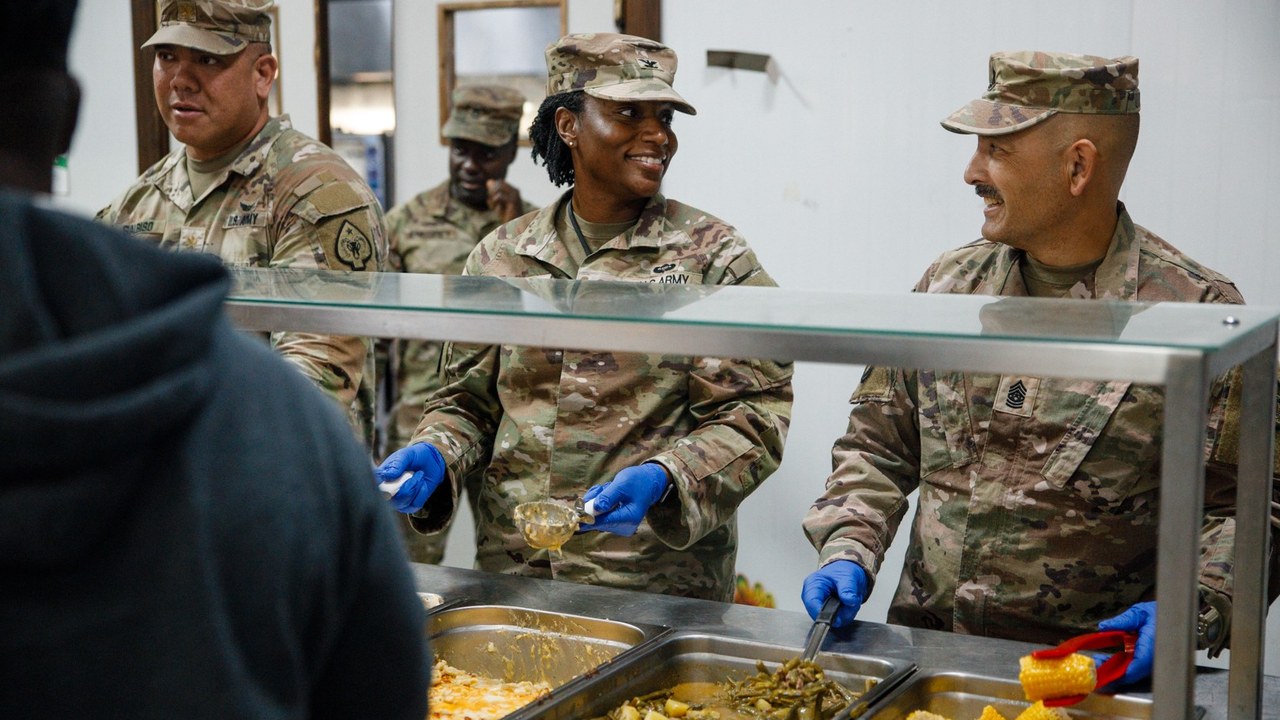
While families across America sit down to turkey today, about 50,000 US troops in the Middle East are doing the same thing — thousands of miles from home, on bases and aboard two aircraft carriers, eating a traditional Thanksgiving dinner that was ordered before summer even started. The Defense Logistics Agency's Troop Support branch delivered more than 585,000 pounds of food for Thanksgiving meals for troops around the world, according to a news release on November 19, 2026. The turkey on a military dining tray overseas was ordered back in the spring.
The number is hard to picture until you break it down. The shipment included 193,459 pounds of turkey, whole and roasted. It included 162,079 pounds of beef and 86,938 pounds of ham — bone-in ham, pork loin and ham hock. It included 128,488 pounds of crab, lobster and shrimp. Then the sides and the sweets: 7,158 cans of sweet potatoes, 8,018 cases of pies and cakes, and 1,321 cases of eggnog. New this year, the order also included about 14,896 pounds of whole pigs. This is not a symbolic gesture. It is a full Thanksgiving, weighed by the pound and shipped by the ton.
The work sits with the Defense Logistics Agency's Subsistence supply chain, the part of the military that feeds the force. DLA Troop Support coordinates with regional commands in Europe and the Indo-Pacific, with service headquarters and with the units being supplied, matching orders to the number of troops at each location. The food has to arrive in time, in good condition, and in the right quantities — and it has to do that for troops scattered across the world, including sailors aboard ships that move.
The Middle East got the largest share of attention this year, with about 50,000 troops there receiving the traditional meal, including sailors aboard two aircraft carriers. A carrier at sea cannot send someone to the store. Everything its crew eats arrives by supply ship or by aircraft, planned weeks and months ahead, and Thanksgiving dinner is no exception. The meal that reaches a sailor's tray today began its journey in a warehouse order placed in the spring.
For the troops themselves, the point is not the tonnage. It is the taste of home on a day when home feels far away. Thanksgiving is the most American of holidays, built around a table and the people at it. A soldier or sailor eating turkey, sweet potatoes and pie on a base in the Middle East is not just eating a meal. They are keeping a tradition that ties them to the families they left behind, served by a supply chain that planned it months in advance.
The scale also says something about how the military thinks about morale. Food is logistics, but Thanksgiving dinner is something more: a deliberate decision to spend real money and real effort making a holiday feel like a holiday, even in a war zone or on a ship at sea. The 585,000 pounds is the receipt for that decision. It sits between recent years: more than 360,000 pounds in 2023, about 700,000 in 2024, and more than 380,000 in 2025.
THE KEY NUMBERS
585,000 — pounds of food delivered for Thanksgiving meals for troops around the world. 193,459 — pounds of turkey, whole and roasted. 162,079 — pounds of beef. 86,938 — pounds of ham, including bone-in ham, pork loin and ham hock. 128,488 — pounds of crab, lobster and shrimp. 14,896 — pounds of whole pigs, new this year. 7,158 — cans of sweet potatoes. 8,018 — cases of pies and cakes. 1,321 — cases of eggnog. 50,000 — US troops in the Middle East receiving the traditional meal, including sailors aboard two aircraft carriers.
THE STORY SO FAR
Spring 2026 — the turkey for overseas military dining trays is ordered, months before Thanksgiving. Nov. 19, 2026 — the Defense Logistics Agency announces the shipment: more than 585,000 pounds of food for Thanksgiving meals for troops around the world. Nov. 26, 2026 — Thanksgiving Day, and about 50,000 US troops in the Middle East sit down to the traditional meal, including sailors aboard two aircraft carriers. The deliveries reached Navy vessels despite operational commitments, global conflicts, host-nation clearance rules, delayed and heat-damaged containers and transportation limits at multiple ports.
WHAT HAPPENS NEXT
The leftovers are the next logistical problem, but the bigger cycle starts again almost immediately. The Subsistence supply chain that planned Thanksgiving in the spring will turn to the Christmas meal next, and then begin the long planning cycle for next year's Thanksgiving before this one is even a memory. The troops who ate today will be somewhere else by then — a different base, a different ship, a different country — and the dinner will find them there too, ordered in the spring and delivered by the pound.
THE HARD PART: GETTING IT THERE
Ordering 585,000 pounds of food is the easy part. Delivering it is where the operation gets hard. Robin Whaley, chief of DLA Troop Support Subsistence's Customer Operations Division, described deliveries to Navy vessels complicated by operational commitments, global conflicts, host-nation clearance rules, delayed and heat-damaged containers, and transportation limits at multiple ports. A container delayed in the heat can spoil a shipment. A port with no room can strand one. A ship that moves on operational orders can be somewhere else when its food arrives. Every one of those problems had to be solved for the dinner to reach the tray today. That is the part of Thanksgiving nobody photographs: not the turkey, but the tonnage, the timing, and the people who made both work.