Just after 11 a.m. on Wednesday, November 25, a wave hit the end of the Pacifica Pier south of San Francisco — and a whole section of the 1,140-foot pier snapped off and dropped into the ocean. The collapse was caught on video, and the clip has been shared millions of times since.
The video, filmed by local outlet NBC Bay Area, shows a huge wave smashing into the end of the pier before a section slowly gives way and tumbles into the surf. Weather observer Colin McCarthy, who runs the US_Stormwatch account on X, shared the footage with the words: “Oh my god, part of the Pacifica Pier just collapsed.” The San Francisco Chronicle reported that the entire outer end of the pier’s L-shaped section tipped backward into the water.
The pier is the Rev. Herschel Harkins Memorial Pier, better known as the Pacifica Municipal Pier. It was built in 1973, stretches 1,140 feet into the Pacific, and the city calls it one of the best fishing piers in California for the number and quality of fish caught from its deck. It has closed for repairs and reopened several times over the last decade — and this time, the closure is almost certainly what saved lives.
The pier has been shut since June 4, when the city closed it after finding cracking, separation and displacement in the concrete walkway and structural elements near the abutment. The decades-old Chit Chat Cafe next to it was demolished over safety concerns. On November 13, the city said it had hired the Dutra Group to replace 300 boulders that had been moved from south of the pier up to the abutment to protect it, work that had just begun and was due to finish in early December. The ocean did not wait.
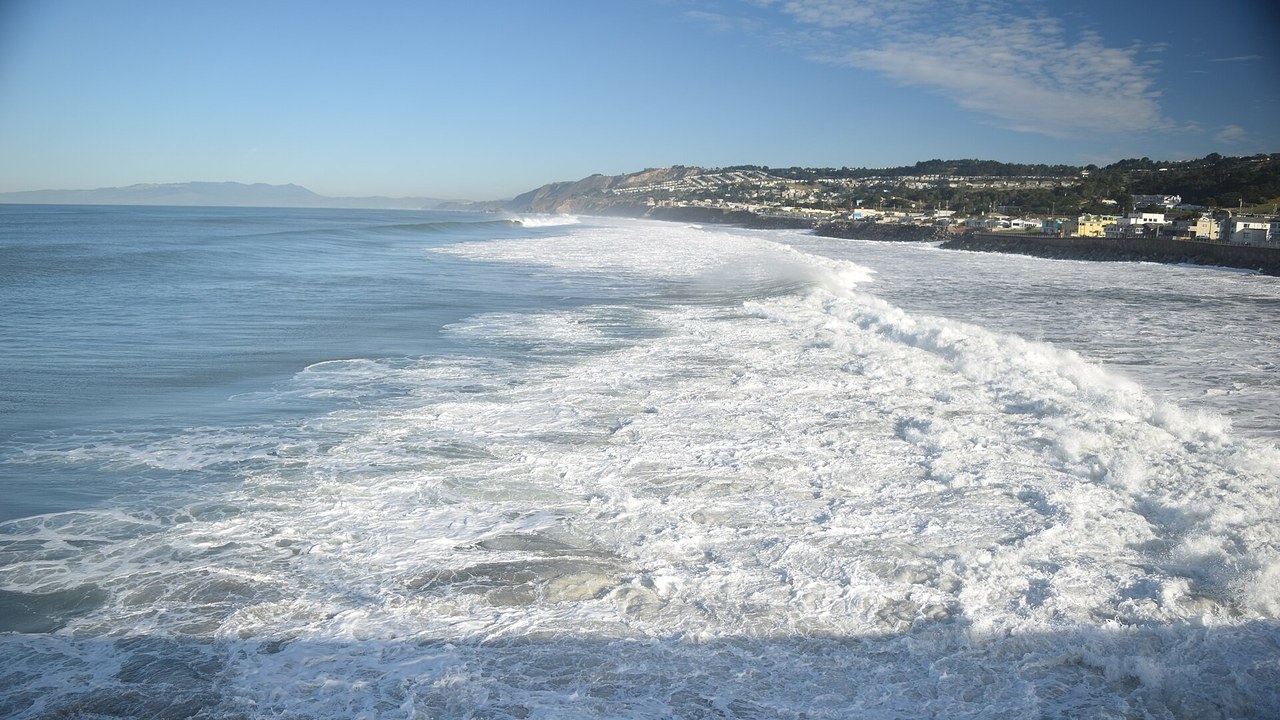
The collapse came in the middle of a brutal week for the California coast. King tides — the highest tides of the year, when the sun, moon and Earth line up to pull the ocean higher than usual — are running on top of a super El Niño that has already raised sea levels along the Pacific coast. Forecasters warned of 20- to 30-foot breaking waves, and San Francisco’s high tide on Wednesday was forecast at 8.5 feet, including up to 1.6 feet of storm surge. In Pacifica, the high tide reached 6.7 feet but was measured more than a foot higher than predicted because of the El Niño swell. The day before, San Francisco had already broken its November tide record — 8.23 feet at the Crissy Field gauge on Tuesday morning, beating 7.97 feet from November 30, 1982.
The same water that took the pier flooded the town behind it. Seawater poured over sandbag lines and into homes in Pacifica’s Sharp Park neighborhood, with floodwater knee-high on some streets more than a block inland, and pumps meant to clear the water were overwhelmed. Santa Cruz evacuated coastal areas and closed its beaches, and in Orange County the record tides flooded multiple homes. Governor Gavin Newsom called the damage in Pacifica “heartbreaking.” State Senator Josh Becker, who had visited the pier the week before with local and state officials to announce new money to stabilise it, said: “The king tides today have caused significant damage to the Pacifica Pier and Beach Boulevard. Thankfully, no injuries have been reported.”
THE KEY NUMBERS
11 a.m. — the collapse, just after 11 a.m. local time on Wednesday, November 25.
1,140 feet — the length of the Pacifica Pier, built in 1973.
20–30 feet — the breaking waves forecast for the Bay Area on Wednesday.
8.23 feet — the Crissy Field gauge reading on Tuesday morning, a new November record for San Francisco.
6.7 feet — Pacifica’s high tide on Wednesday, measured more than a foot higher than predicted.
300 — the boulders in the repair contract signed on November 13 to protect the pier’s abutment.
June 4 — the date the pier closed to the public, the reason nobody was on it when it fell.
0 — the number of injuries reported.
IF YOU ARE HEADING TO THE CALIFORNIA COAST
The National Weather Service’s warning is blunt: “Everyone should remain out of the water due to life-threatening surf conditions.” The high surf warning for the San Francisco coast runs until midnight on Wednesday, and the coastal flood warning runs until Thursday afternoon. Stay off piers, jetties and seawalls while the swell is running, keep off flooded roads — seawater hides the road underneath — and never turn your back on the ocean.
THE STORY SO FAR
1973 — the Rev. Herschel Harkins Memorial Pier opens in Pacifica, south of San Francisco.
June 4, 2026 — the city closes the pier after engineers find cracking, separation and displacement in the concrete near the abutment. The Chit Chat Cafe is later demolished.
November 13, 2026 — the city hires the Dutra Group to replace 300 boulders at the pier’s abutment. Work begins that week, due to finish in early December.
Tuesday, November 24 — San Francisco breaks its November tide record at 8.23 feet. Floods hit Marin County and Humboldt County.
Wednesday, November 25, just after 11 a.m. — a huge wave snaps off the outer end of the pier’s L-shape. The collapse is filmed and shared around the world within hours.
Wednesday afternoon — seawater floods streets in Pacifica’s Sharp Park neighborhood and Santa Cruz evacuates coastal areas.
WHAT HAPPENS NEXT
The city has yet to say publicly what happens to the pier — PEOPLE reported on Wednesday that Pacifica had not addressed the collapse. Engineers will need to assess how much of the structure is still sound before anyone can say whether the lost section is rebuilt or the pier is shortened for good. A city official told the Los Angeles Times that the section that fell had come down in previous storms, so its loss was “not completely unexpected.” What is certain is the timing: the king tides run through Thursday, the swell stays dangerous, and the coast is not done with this storm yet. The pier that survived 53 years of Pacific winters lost its end in a single morning — and the water that took it is still coming in.