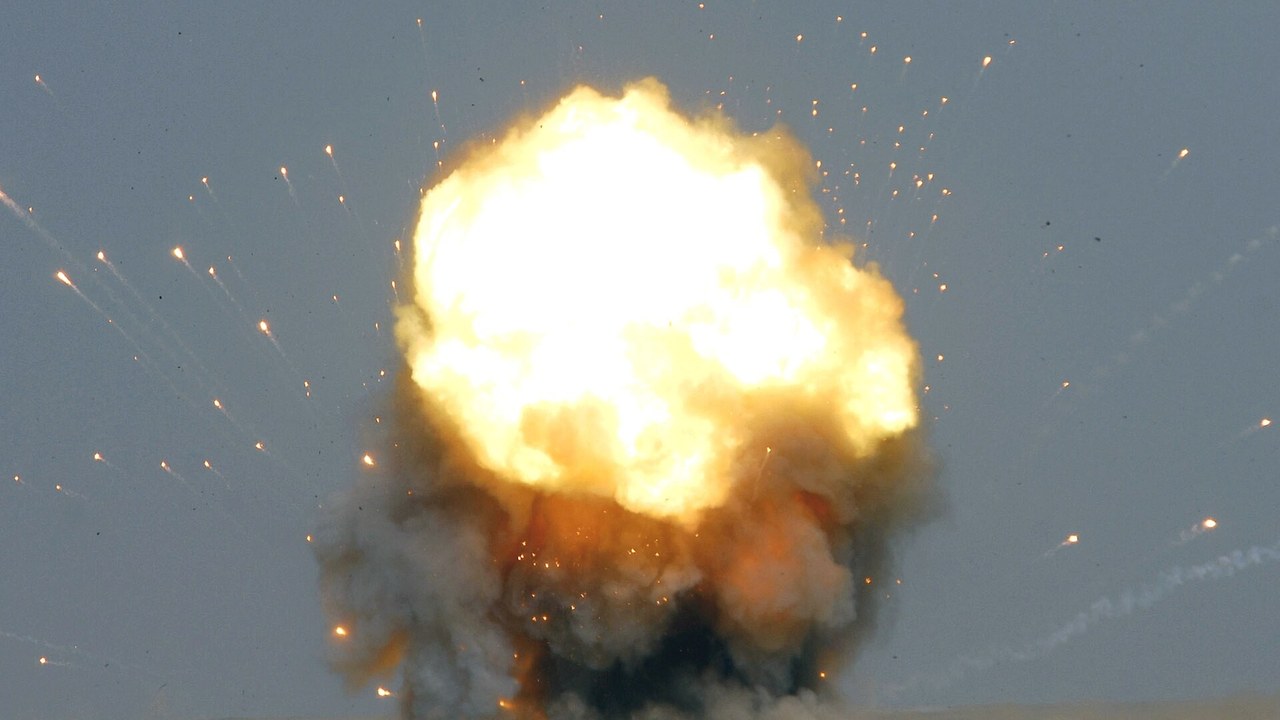
The US Army is going to blow up nearly five tons of explosives in Iowa on Wednesday morning — on purpose. A federal appeals court cleared the way on Monday evening, and the Army confirmed the controlled detonation of 9,500 pounds of degraded lead azide at the Iowa Army Ammunition Plant will go ahead, the day before Thanksgiving.
The blast will deal with 68 barrels of lead azide, a compound used to detonate military munitions, stored at the World War II-era plant in Middletown, Iowa — a town of about 363 people. The plant spans about 19,000 acres near the Illinois border.
The rush is about the state of the material. Stored for around 20 years, the lead azide has recrystallized inside its containers, leaving it, in the Army's own words, "extremely unstable and sensitive to even slight friction or movement." The Army says it cannot be moved — transporting it could set it off — and falling temperatures could make it explode on its own. That is why the date has already slipped three times.
The detonation nearly did not happen at all. On Monday afternoon, President Donald Trump announced he had ordered the military to hold off until the Court of Appeals for the Eighth Circuit and Iowa's governor-elect, Rob Sand, both agreed. "I feel the proper course is to get rid of this longterm problem but, at the same time, have ordered the Military not to do so until such time as the Eighth Circuit agrees that we can go forward," Trump wrote on Truth Social.
Hours later, the court ruled. A three-judge panel of the Eighth Circuit lifted the temporary stay, finding the EPA had "adequately incorporated safeguards to minimize the dispersal of lead dust" and that the explosives "present a risk of an uncontrolled and unplanned explosion, which would occur without the benefit of the safety measures that the Permit puts in place." Within hours, Acting Army Secretary Adam Telle announced on X that the blast would go ahead Wednesday morning "as previously scheduled, based on forecast wind conditions."
"Every expert agency agrees, and both Iowa's current and incoming Governors say the call belongs to the experts. We are proceeding with the controlled removal in full coordination with all state, local and federal authorities, because the safety of Iowa's citizens comes first." — Acting Army Secretary Adam Telle, on X, Monday evening
THE STORY SO FAR
January–March 2026 — The Army begins evaluating the material, and on March 12 notifies the EPA it must be disposed of.
November 13, 2026 — The EPA permit takes effect, authorizing a controlled detonation to manage the explosive hazard.
November 15, 2026 — The Army publicly announces the plan and tells nearby residents to vacate the area for most of the day.
Thursday, November 19, 2026 — The Iowa Environmental Council and the Sierra Club file an emergency motion to stop the blast. The Eighth Circuit grants a temporary stay the same day.
Friday, November 20, 2026 — The original detonation date passes under the stay. The Army reschedules to Monday, then Tuesday, then Wednesday.
Saturday, November 21, 2026 — The Justice Department asks the court to lift the pause, warning of "the more significant threat from an uncontrolled explosion."
Monday, November 23, 2026 — Trump orders the military to wait for the court and governor-elect Sand. That evening, the panel lifts the stay, and Telle confirms the Wednesday blast.
THE KEY NUMBERS
9,500 pounds: the lead azide to be detonated — about five tons, held in 68 barrels.
Wednesday, November 25: the detonation morning, the day before Thanksgiving. The exact time depends on wind.
About 100 miles: how far Army maps show the lead-particle plume could travel.
19,000 acres: the size of the Iowa Army Ammunition Plant. Middletown, the town beside it, has about 363 residents.
November 13 to February 11, 2027: the window of the EPA's emergency permit for the detonation.
Zero: the safe level of lead in the body. Lead is toxic to the brain and can have severe health effects, especially in children, the CDC says.
WHAT IS LEAD AZIDE — AND WHY CAN'T THEY JUST MOVE IT?
Lead azide is a primary explosive — the small, sensitive charge that sets off a much larger munition. It detonates easily — which is also what makes it dangerous to store. Left in its containers for around two decades, the crystals have grown and changed shape — recrystallization — until the Army says even slight friction or movement could set it off. Cold weather makes it worse: a temperature drop could set it off before any planned blast. Moving it was the first idea, and the Army ruled it out for the same reason — the material sits buried under layers of earth and concrete, and the Army says the only safe way to treat it is to detonate it where it is.
The Army did try another route first: it hired MuniRem Environmental, a Georgia firm that neutralizes munitions with chemicals, but canceled the deal citing safety concerns. The Justice Department put the choice bluntly in its court filing: "The real choice, in other words, is not between a detonation and no detonation. It is between a planned and mitigated detonation and an unplanned and unmitigated explosion." A planned blast is timed for favorable wind, preceded by public notice, and followed by monitoring and cleanup. An accidental one comes with no warning at all.
WHAT HAPPENS NEXT
Wednesday morning is the moment of truth. The Army will detonate the material at the plant, under layers of earth and concrete, with state, local and federal authorities on hand. Monitoring and cleanup follow, and the plume's path will be tracked. The groups' challenge to the EPA permit is still in the courts — the panel only lifted the emergency pause — but with the stay gone, nothing now stands between the Army and Wednesday morning.
For people in Middletown and southeastern Iowa, the worry does not end with the blast. Residents have pressed the Army about how lead could affect their health, their farm animals and their land, and the plume maps show particles could travel close to 100 miles. The Army's answer is that every expert agency — from the Army and Navy to the EPA, FBI and CDC — agrees the controlled blast is the safer of two bad options. On Wednesday morning, Iowa finds out whether that bet was right.