Picture a Viking. The image arrives fully dressed: the beard, the axe, the ship with its carved prow — and on his head, a helmet with two great curved horns. It is on costumes, cartoons, sports mascots and pub signs across the world. It is also, according to everything archaeology has managed to find in more than a century of digging, entirely made up.
The Claim (And Every Halloween Costume)
The claim is not subtle, which is part of its charm: Viking warriors, it says, went raiding and fighting wearing horned helmets, the way knights wore plumes. If it were true, the evidence would be everywhere — helmets were prestige objects, buried with their owners, exactly the kind of thing that survives in graves by the hundreds. Viking swords survive. Viking brooches, coins, ships survive. So the case for the horned helmet can be tested in the most old-fashioned way possible: show us one.
What Archaeologists Actually Found
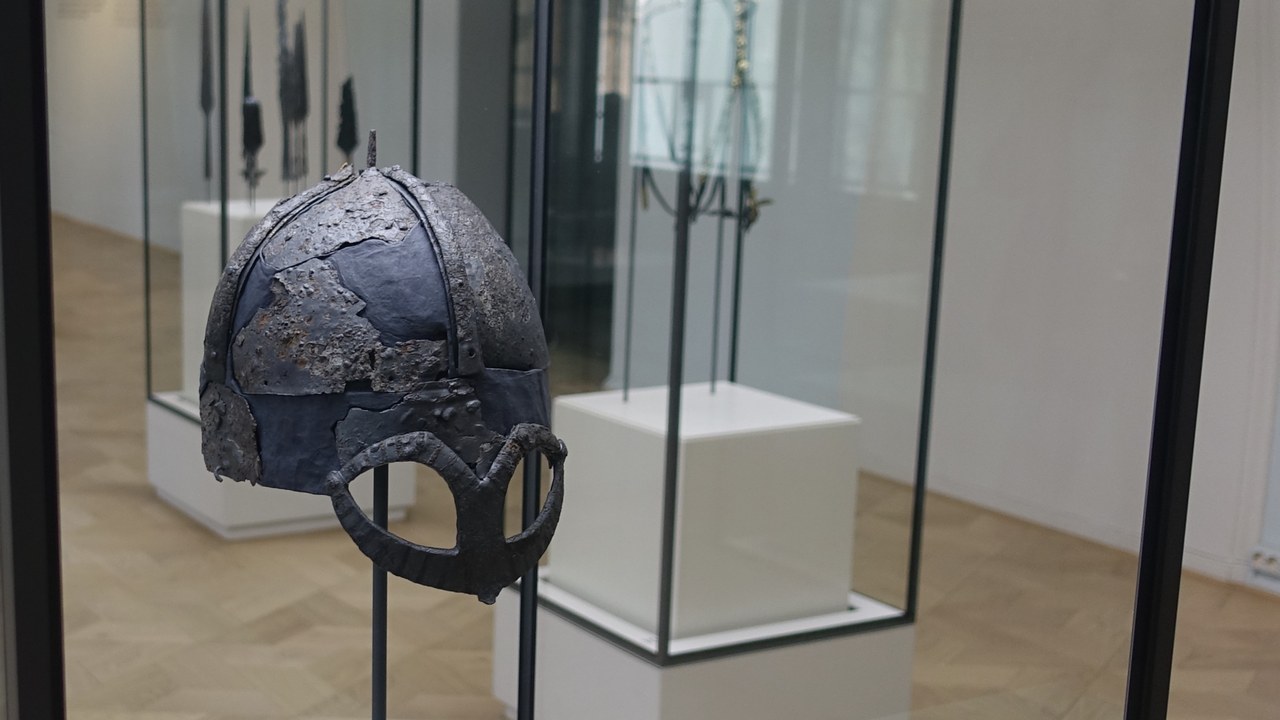
Nobody can. Across hundreds of excavated Viking graves and hoards, not a single horned helmet has ever been found — and helmets of any kind are vanishingly rare, because iron was valuable and most warriors likely fought in leather or cloth caps, or bareheaded. The one great exception proves the rule in the plainest possible way. In 1943, a burial mound on the Gjermundbu farm in Norway yielded the only nearly complete Viking Age helmet ever recovered: a rounded iron cap, built from plates, fitted with a small spike and a mask-like 'spectacle' guard protecting the eyes and nose. It belonged, with its mail shirt and weapons, to a man of status — a chieftain's gear, the finest the age produced. No horns. No fittings for horns. No apology for their absence. The real Viking helmet, at its most elite, was a sensible iron hat.
Common sense seconds the archaeology. Horns on a fighting helmet are a design flaw with a body count: they catch blades that should glance off, they give an opponent something to grab and wrench your neck with, and they snag on rigging, doorways and branches. Cultures that fought for a living did not bolt handles onto their own heads.
The Vikings' own art agrees with the graves. The picture stones, carvings and small figures the Norse world left of itself show its warriors bareheaded, or helmeted in plain caps, or wearing the conical styles common across early medieval Europe — never horned. This was a culture that carved its heroes obsessively, in stone, wood, metal and bone, and celebrated their gear down to the brooches on their cloaks. Somehow, across all of it, not one artist carved the single most distinctive item of equipment the modern imagination insists upon. The horns are absent from the ground, absent from the art and absent from the sagas. They are present, in force, only from 1876 onward — which is not the Viking Age. It is the age of the steam press, the illustrated magazine and the grand opera production.
The finest Viking helmet ever found is a sensible iron hat. The horns were added nine centuries later — by a costume department.
The Opera House Did It
So if the Vikings did not wear the horns, who put them there? The trail ends, delightfully, at the theater. In the 19th century, Scandinavia's Viking past was being romantically revived in art and literature, and illustrators — the Swedish artist August Malmström among them — began crowning their saga heroes with horns for dramatic silhouette. Then came the decisive moment: the first full production of Wagner's Ring Cycle at Bayreuth in 1876, whose costume designer, Carl Emil Doepler, dressed the opera's mythic warriors in horned helmets. Opera was the blockbuster medium of its age, and Doepler's designs were reproduced everywhere. The horned Viking stepped off the stage and into the world's visual vocabulary, where he has been raiding ever since — Halloween parties, mostly.
The Bronze Age Helmets That Are Real
One honest complication makes this story better, not worse: horned helmets genuinely exist in the Scandinavian record. In 1942, two bronze helmets with long, sweeping horns were pulled from a peat bog at Veksø in Denmark — decorated with the beak and eyes of a bird of prey, and dated to around 900 BC. They are masterpieces, and they sit today in the National Museum of Denmark. But they are Bronze Age ritual objects, made something like 1,700 years before the first Viking longship — ceremonial pieces from a world of bog offerings and sun cults, no more 'Viking' than a Roman toga. Whether dim memories of such objects seeded the later confusion, nobody can say. What can be said is exact: horned helmets are real, Danish and spectacular — and they belong to a people separated from the Vikings by a span longer than the one separating the Vikings from us.
The Verdict
The Vikings fought in plain iron, leather or nothing at all; the horns were tailored in the 1800s for singers. If you wear them this Halloween, wear them accurately — as a tribute not to the Viking Age, but to the 19th century's magnificent, unstoppable talent for improving it.