Look at a calendar and you will notice something odd about Veterans Day. Almost every other federal holiday drifts to a Monday — Martin Luther King Jr. Day, Presidents Day, Memorial Day, Labor Day, Columbus Day. Veterans Day never does. It is November 11, whatever day of the week that happens to be, and this year that means a Wednesday. The reason is more than a century old, and it comes down to a single hour: the eleventh hour of the eleventh day of the eleventh month.
The Morning The Guns Stopped
World War I — known at the time as the Great War — ended in practice on November 11, 1918. In a railway carriage parked on a siding in the forest of Compiègne, France, a German delegation signed an armistice, a temporary cessation of hostilities, at 5:10 in the morning. The ceasefire was set for 11 a.m. Paris time, six hours later, so that word could reach every unit along hundreds of miles of front. When the guns finally stopped, they had been firing, by the Australian War Memorial's count, for 1,567 consecutive days. The war itself would not officially end for another seven months, until the Treaty of Versailles was signed on June 28, 1919 — but November 11, 1918 is generally regarded as the end of the war to end all wars.
From Armistice Day To Veterans Day
The anniversary became a commemoration almost immediately. In November 1919, President Woodrow Wilson proclaimed the first Armistice Day, and his original idea was striking: the day should be marked by a two-minute suspension of business beginning at 11 a.m., a silence for the moment the guns stopped. In 1926, Congress gave Armistice Day its official name, and in 1938 an act of Congress made November 11 a legal federal holiday, dedicated to the cause of world peace and set aside to honor veterans of World War I. Then came the Second World War and Korea, and millions more Americans had served in wars the holiday's name did not cover. In 1954, Congress struck out the word Armistice and inserted Veterans — Public Law 380, signed by President Dwight D. Eisenhower on June 1, 1954 — and November 11 became a day to honor American veterans of all wars. Raymond Weeks of Birmingham, Alabama, who had organized a parade on November 11, 1947 to honor all veterans, is widely credited with pushing the broader idea.
The Monday Experiment — And Why It Failed
Here is the part most people have forgotten: Veterans Day did move to a Monday once, and the country hated it. The Uniform Monday Holiday Act of 1968 moved several federal holidays to Mondays to create three-day weekends, and Veterans Day was shifted to the fourth Monday in October. The first Veterans Day under the new law was observed with much confusion on October 25, 1971. Veterans groups objected — the date was the whole point — and states began drifting back to November 11 on their own. On September 20, 1975, President Gerald Ford signed Public Law 94-97, which returned the annual observance of Veterans Day to its original date of November 11, beginning in 1978. It has been fixed there ever since, written into federal law at 5 U.S.C. 6103 as Veterans Day, November 11 — no apostrophe, by the way, according to the Department of Veterans Affairs and the Office of Personnel Management.
The Poppy
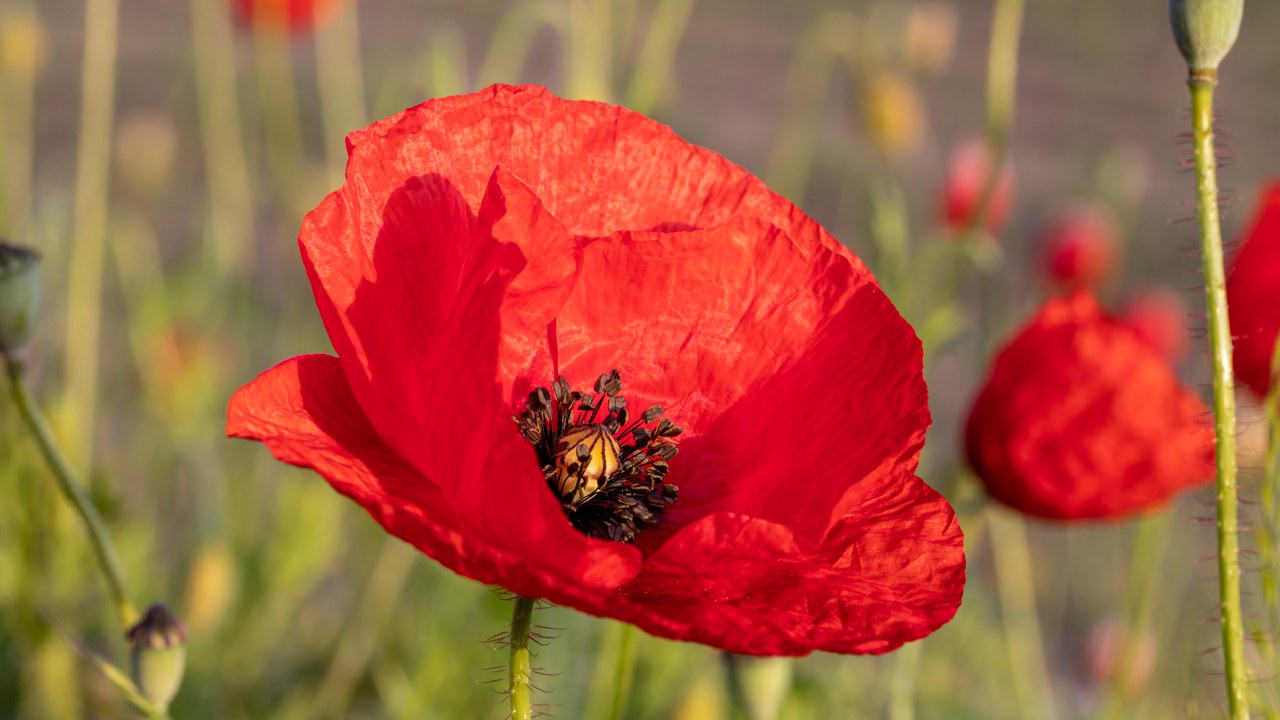
There is one more symbol tied to the date, and you will see it today if you look: the red poppy. It comes from 'In Flanders Fields,' the poem Lieutenant Colonel John McCrae, a Canadian army doctor, wrote in 1915 after burying a friend on the Western Front — poppies were among the first flowers to grow over the soldiers' graves. The poppy became the flower of remembrance across the Commonwealth, worn on Remembrance Day, which is also November 11, and it is why the fields in our photograph are red. In the United States the poppy is less central than the flag, but the idea is the same: a date, an hour, and a flower, all chosen by the war itself rather than by any committee.
Why The Date Still Matters
There is a reason the date survived a law, a decade of confusion and a century of calendar drift. November 11 is not an arbitrary day on which a holiday happens to sit — it is the anniversary of the moment itself. At 11 a.m. today, wherever you are, the silence that Wilson asked for in 1919 still means something: a war that killed millions ended because, at an agreed hour, the shooting stopped. That is why the free meals and the parades and the flags all land on this date, and why they always will. The eleventh hour of the eleventh day of the eleventh month — a date chosen by history, not by a calendar committee.