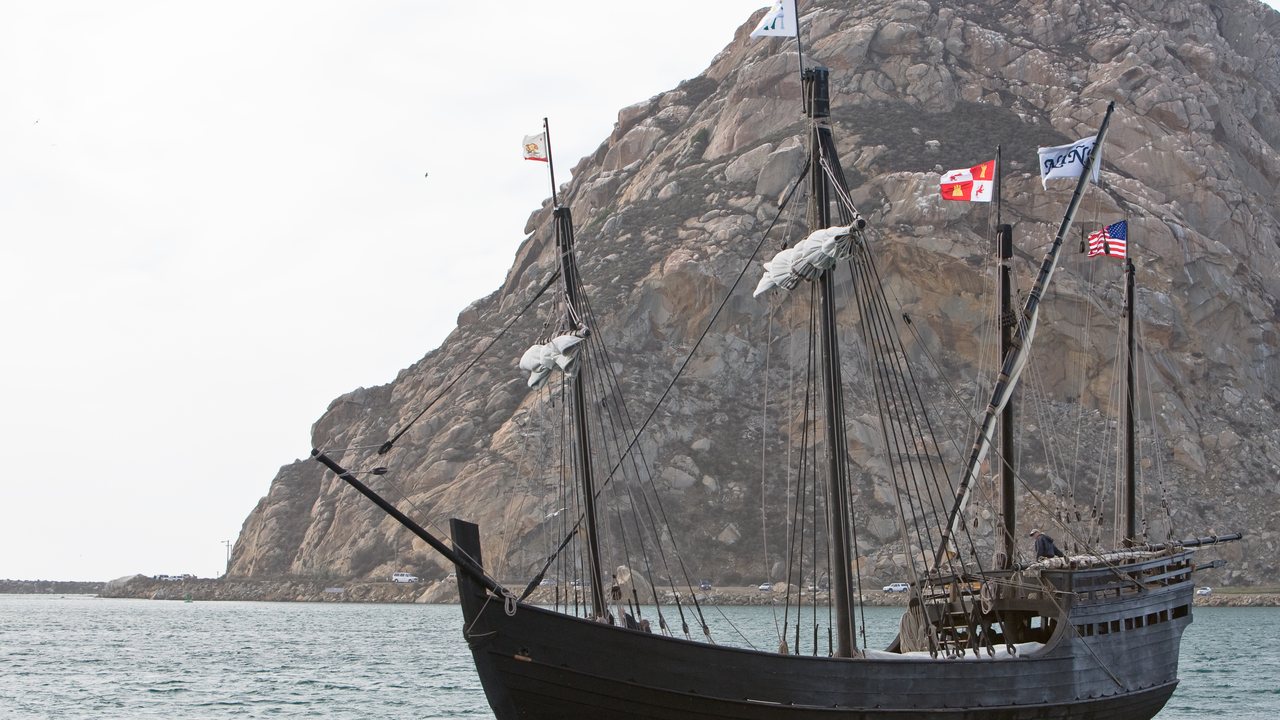
It may be the most famous scene in the history of exploration: Columbus before the learned men of Spain, arguing that the Earth is round while flat-earth churchmen warn that his ships will sail off the edge of the world. Every element of that scene is a credit to its author. There is just one problem — he was not a witness, a chronicler or a contemporary. He was a novelist, writing in 1828, more than three centuries after the fact.
The Claim From Every Schoolbook
The claim runs like this: in 1492, people — scholars included — believed the Earth was flat, and Columbus's voyage was a brave empirical refutation, science against superstition, with the sailors terrified of the drop at the world's rim. It is taught early, illustrated vividly and remembered forever. It is also, in the verdict of the historians who specialize in exactly this question, an invention — and an unusually well-documented one, because we can name the book that built it.
What Scholars Knew Since Eratosthenes
Begin with the record the myth erases. Greek scholars had established the Earth's spherical shape in antiquity — not as a guess but as a conclusion from evidence anyone could check: the round shadow Earth casts on the Moon during eclipses, the way ships vanish hull-first over the horizon, the changing stars as you travel north or south. Around 240 BC, Eratosthenes went further and measured the planet, comparing shadows in two Egyptian cities and computing the circumference with an accuracy that still impresses surveyors.
That knowledge was never lost. Through the early and later Middle Ages, the spherical Earth was the standard teaching of the universities — the era's astronomy textbooks were built around the sphere, and virtually all scholars maintained it. The picture of a medieval world trembling at the edge of a flat disc is not a discovery about the Middle Ages. It is a rumor about them, started much later, by people with a use for it.
The flat-earth Middle Ages are not a discovery about the past. They are an invention of the 1800s — a foil built to make modernity look heroic.
Columbus's Real Argument (He Was Wrong)
Columbus absolutely faced expert opposition — the committees in Spain and Portugal that examined his proposal were skeptical, and their skepticism is the historical seed the myth grew from. But their objection had nothing to do with shape. Everyone at the table knew the world was round. They argued about its size. Columbus had embraced the smallest available estimate of the Earth's circumference and the largest available estimate of Asia's width, shrinking the ocean between Europe and Japan to a distance he reckoned a ship could survive. The experts, working from figures much closer to the truth, told him the ocean was far too wide — that his crews would starve in an endless sea.
They were right. On the experts' numbers, Columbus's plan fails: no 1492 ship could have crossed the true expanse of ocean between Spain and Asia. The voyage succeeded because an entire continent that neither side knew about was standing in the way, roughly where Columbus's miscalculations needed land to be. History's verdict is therefore the reverse of the schoolbook's: Columbus was the one in error, the 'ignorant' committee was correct, and only the Americas saved him from proving it with his life.
The 1800s: How The Myth Was Manufactured
So how did the true story — a dispute about distance, in which Columbus was wrong — become the famous one about shape, in which he was a martyr for reason? The historian Jeffrey Burton Russell traced the fabrication in his book Inventing the Flat Earth, and the trail leads to Washington Irving. Irving's romanticized biography, A History of the Life and Voyages of Christopher Columbus, published in 1828, dramatized Columbus before the council at Salamanca as a lone rationalist pleading for a spherical Earth against benighted churchmen quoting scripture for a flat one. The scene was Irving's invention — the real deliberations concerned the size of the globe and the distance to Asia — but it was magnificent storytelling, and it spread through the century's textbooks like dye through water. Samuel Eliot Morison, the great Columbus biographer, called Irving's version 'pure moonshine' and 'misleading and mischievous nonsense.' Later writers — John William Draper and Andrew Dickson White, marshaling history for a grand war between science and religion — seized the scene and armed it.
Notice the pattern one last time: the myth flatters its tellers. A fabricated ignorant past makes the present feel enlightened by contrast — which is precisely why the 19th century bought it, and why it still sells.
The Verdict
Nobody of consequence in 1492 thought the Earth was flat, because nobody of consequence had thought so for nearly two thousand years. Columbus did not prove the world round; he misjudged its size and was rescued by a continent. The flat Earth in this story is real — but it is the one in the schoolbooks, invented in 1828, and we are the ones who have been living on it ever since.