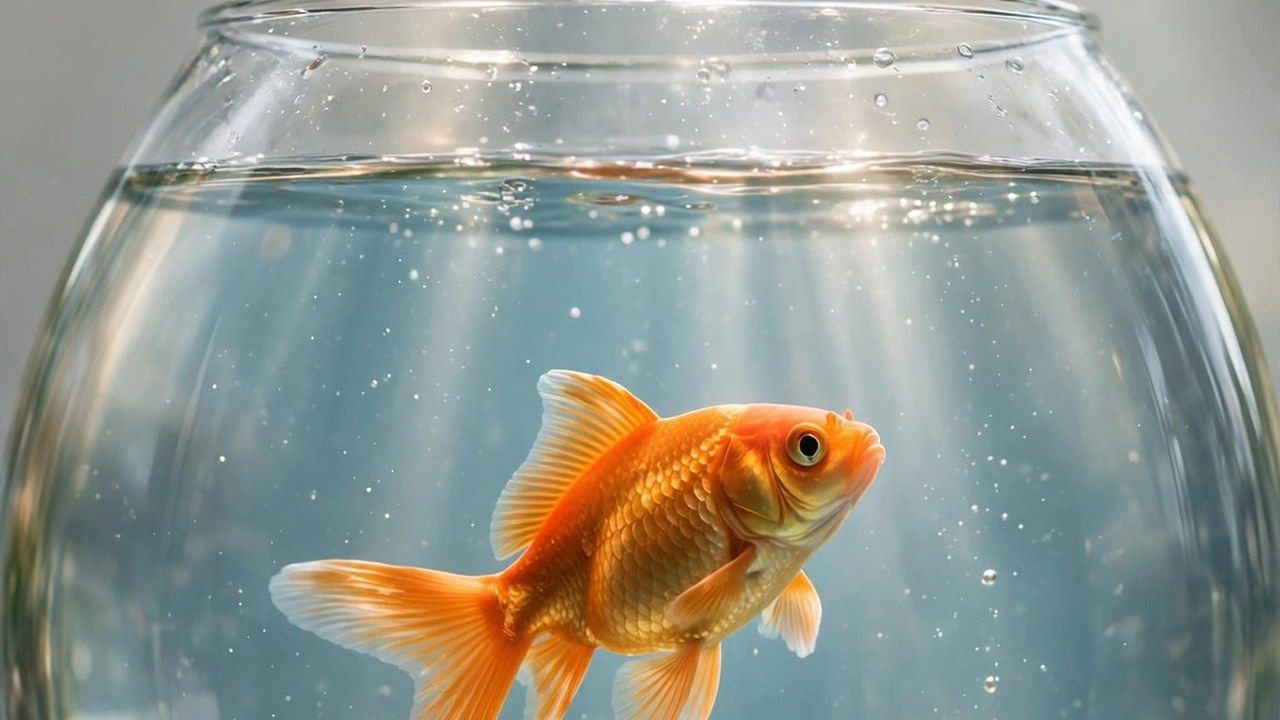
Every language has its insult for a forgetful person, and an astonishing number of them involve this fish. The goldfish, we are told, has a memory of three seconds: it circles its bowl in a state of perpetual discovery, forever meeting the little plastic castle for the first time. It is a charming image. It is also one of the most thoroughly disproven claims in all of animal folklore — disproven not by argument, but by goldfish themselves, in laboratories, learning things.
The Claim
Consider what the claim asserts: not that goldfish memory is short, or simple, or worse than a dog's — but that it effectively does not exist, expiring in less time than it takes to read this sentence. A creature with a three-second memory could not learn where food appears, could not habituate to a tank mate, could not improve at anything. And yet anyone who has kept goldfish has watched them gather at the feeding corner before the food arrives — behavior that is, by definition, memory. The claim was always in trouble at home. In the lab, it collapsed entirely.
The Fish That Learned To Tell Time
In controlled studies, goldfish have been trained to press a lever to release food — a straightforward learned behavior that already requires remembering which action pays. Then the experiments got ruder to the myth: the lever was rigged to pay out only at a specific time of day. The goldfish learned that too, pressing at the right hour and largely ignoring the lever when it was not worth pressing. An animal with a three-second memory cannot learn a schedule. A schedule IS a memory — of what happened yesterday at this time, applied to today.
Other work has piled on. Goldfish have been run through mazes and learned routes. They have been conditioned to distinguish signals — colors, sounds, cues — and to keep those associations over long stretches. And the retention is not measured in seconds or days but in months: trained behaviors and learned associations persist across timescales that make the famous figure look less like science and more like a rounding error of a hundred thousand percent.
A schedule is a memory. The goldfish that presses a lever at the right hour is keeping one.
Mazes, Colors And Familiar Faces
The most quietly devastating evidence for the prosecution is the one aquarists have reported all along: goldfish recognize people. Not 'respond to movement near the glass' — recognize, distinguishing the familiar human who feeds them from strangers, and reacting accordingly, gathering for one and ignoring or shying from the other. Recognition of an individual face, retained across encounters, is a memory feat that sits very oddly next to a three-second claim. Add maze-learning, cue-learning and time-learning, and the portrait that emerges is of a perfectly ordinary fish brain — modest, functional and built, like every vertebrate's, to learn from experience and keep the lessons.
Where "3 Seconds" Came From (Nowhere)
So who measured the three seconds? Nobody. There is no experiment behind the figure, no paper, no laboratory, no researcher anyone can name. The number appears to be pure folklore, and its most plausible birthplace is the bowl itself. A goldfish in a bare glass sphere lives in an environment with almost nothing in it worth remembering — no territory, no landmarks, no events. Watching an animal drift in an empty world, owners mistook the emptiness of the world for the emptiness of the mind. The fish was not forgetting its surroundings every three seconds. Its surroundings were simply giving it nothing to remember — a distinction the myth never bothered to make, and one a survey of 2,000 adults still misses: two-thirds of them refuse to believe goldfish remember for months.
What This Means For Your Fish Tank
The correction is not merely trivia, because beliefs have husbandry consequences. A pet believed to forget everything can be kept in a bare bowl without guilt; a pet known to learn, remember and recognize is a different responsibility. Enrichment — plants, structures, variety, space — matters to an animal that retains its experiences, and so does consistency of routine, the very thing goldfish demonstrably use. The humble goldfish turns out to be keeping a diary of its life in the only ink it has. The least its owners can do is give it entries worth keeping.
It also reframes the fish's famous circling. A goldfish patrolling its tank is not rebooting every three seconds into a brand-new world, meeting the same castle with fresh amazement. It is an animal moving through a familiar map that it remembers — checking the feeding corner, the plant it shelters by, the route through the gravel it learned last week and the week before. The behavior never changed, for as long as people have kept these fish. Only the story we told about it was wrong — and the fish, circling patiently, out-remembered us all along.
The Verdict
Three seconds was never a measurement; it was a punchline that hardened into a fact. The measured truth — memories lasting months, learned schedules, recognized faces — makes the goldfish more impressive, not less. If anyone in this story has a memory problem, it is the species that kept repeating the claim for decades without checking it.