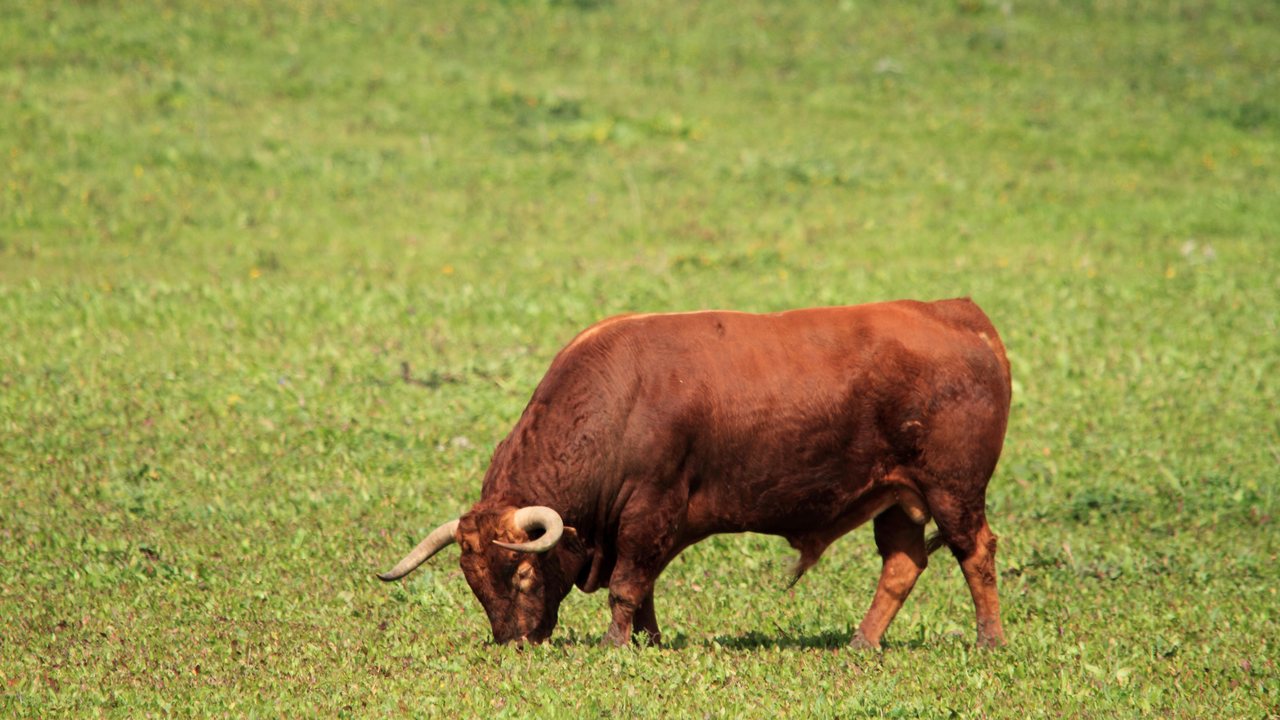
The scene is known to people who have never seen a bullfight: the matador plants his feet, sweeps the great cape wide, and the bull — maddened, supposedly, by the sight of that blood-bright red — lowers its horns and charges. Red means rage, says the story: the color itself is the insult. It is a perfect piece of folk biology, and it runs into a single fatal obstacle. The bull cannot see it.
The Claim
State the claim as it is usually meant: bulls are provoked by the color red — the hue triggers the charge. It feels plausible because the correlation is total: in every image of the corrida, the cape is red and the bull is charging. But correlation hides a confound that any experiment can split in two, because in every one of those images, the cape is also moving. Red and motion arrive together, every time. To find out which one the bull is actually answering, you have to separate them — and animal scientists, whose knowledge of cattle vision is among the most complete for any farm animal, separated them long ago.
How A Bull Actually Sees
Human vision is trichromatic: three color channels, letting us distinguish reds from greens at a glance. Cattle are dichromats. Their eyes run on two channels, tuned toward blues and yellows, and along the red-green axis they are effectively colorblind. A ripe tomato, a green field and the matador's scarlet cape do not present themselves to a bull as a traffic light of distinct hues; red registers as a dull, darkish shade — a tone, not a provocation.
Sit with the consequence. When the bull charges the muleta, it is charging at something it perceives roughly the way you would perceive a gray-brown flag in dim light. The most famous color in the ring is, to the animal at the center of the spectacle, not a color at all. Whatever is bringing six hundred kilos of bull downhill at a man with a cloth, it is not the wavelength.
To the bull, the cape is not red. It is not even colorful. It is moving — and that is the whole story.
The Movement Experiments
The test writes itself, and it has been run in various forms by researchers and, memorably, by television science programs with more courage than most: present a bull with cloth of different colors, still, and with cloth of one color, moving. The results are boring in the way conclusive results tend to be. A still cape — red included — is largely ignored. A moving cape — white, blue, green, red, it does not matter — draws the charge. Change the color and keep the motion: charge. Keep the color and remove the motion: no charge. The variable that runs the experiment is movement, every time.
This matches the bull's whole behavioral world. Bulls charge at things that move into their space, that loom, that flap, that intrude and irritate — dogs, people, vehicles, other bulls. Color is simply not on the list of things a bovine brain is built to take offense at. It cannot be. The hardware to detect the alleged insult is not installed.
Stockmen have, in effect, always known this, whatever the folklore said. Handlers calm cattle by moving slowly and steadily, precisely because sudden motion is what spooks and provokes — the flapping jacket, the waving arm, the dog darting at the heels. A red jacket waved in a bull's face will draw its attention; the same jacket, red as a postbox, hanging motionless on a fence will be ignored all afternoon. Farmyards ran this experiment informally for centuries before laboratories ran it formally, and both arrived at the same answer: in a bull's world, things are dangerous because they move. The color is a detail only the spectators are equipped to care about — which is fortunate, since the spectators are the ones who bought tickets.
Why The Cape Is Red (For Us, Not Him)
If the bull is indifferent, why is the muleta scarlet? Because the spectacle has two audiences, and only one of them can see red. The cape's color is tradition and stagecraft for the humans: centuries of corridas fixed the crimson cloth as the uniform of the final act, a blaze of color against the sand that reads from the highest seat in the plaza. It is also often said that red was chosen or kept because it masks the blood of the bull as the fight reaches its end — sparing the crowd the full sight of the wound. Whether that was the original reason or a later justification, both explanations point the same way: the color serves the spectators. The bull, charging at movement and menace, never got a vote on the palette.
The Verdict
Bulls do not hate red, because bulls cannot see red. They charge at motion, intrusion and irritation — at the wave of the cloth, not its dye. The cape is red for the same reason a theater curtain is: the audience is human, and red is for us.