Here is the claim, in the form everyone has heard: bats are blind. “Blind as a bat” is one of the most common phrases in English, and it sounds like common sense. Bats fly at night. They navigate by sound. So they must not be able to see. It is a neat little story. It is also wrong — and the science that proves it has been settled for years.
The Smithsonian Institution states it flatly: all bats can see, even though vision may be less important than other senses in many species. Bat Conservation International is even more direct: bats are not blind — despite the common phrase, all bats have functional eyes and can see. The U.S. National Park Service makes the same point in plainer language: bats are not blind, but many rely on a high-tech, sound-based system to orient themselves. There is no known bat species in which vision is absent. Bats are mammals, and like other mammals they have eyes with retinas, lenses and optic nerves that work.
The Claim
The myth has a grain of truth at its centre, which is why it survives. Echolocation is real, and it is spectacular. Bats produce high-frequency calls and interpret the returning echoes to navigate and hunt in complete darkness — a system first documented in 1939, when Donald Griffin, working in a Harvard laboratory, showed that bats were navigating with sound waves and echoes. In darkness, echolocation has a real advantage over vision, because the bat supplies the signal itself. It can also resolve the distance to a small nearby target more precisely than eyes can.
But using a sense in darkness no more proves blindness than using headlights at night proves a driver cannot see. The two systems do different jobs, and bats use both. Vision detects light reflected from the environment and provides information from distant landmarks whenever enough light is available. Echolocation handles the close-up work in the dark. A bat gains from combining the systems rather than discarding either one — and the experiments show exactly that.
What The Experiments Actually Show
In a 2019 study published in Science Advances, researchers tested Egyptian fruit bats, which can use both vision and tongue-click echolocation. When both visual and echo information were available for distinguishing shapes, the bats relied primarily on vision. One species cannot represent the entire bat order, but the experiment directly disproves the idea that echolocating bats are incapable of using sight.
The anatomy backs it up. A 2009 study in the journal PLOS ONE examined two New World leaf-nosed bats — Pallas's long-tongued bat and Seba's short-tailed bat — and found substantial cone populations in their retinas, including receptors that may let them see ultraviolet light, wavelengths outside the human visual spectrum. A large 2018 analysis in the journal eLife examined retinas from 187 individuals across 56 Neotropical bat species and found the visual machinery broadly retained. And a 2026 study in Current Biology measured robust visually driven eye movements in Seba's short-tailed bats — the eyes are not decoration. They are working, stabilising gaze, every night.
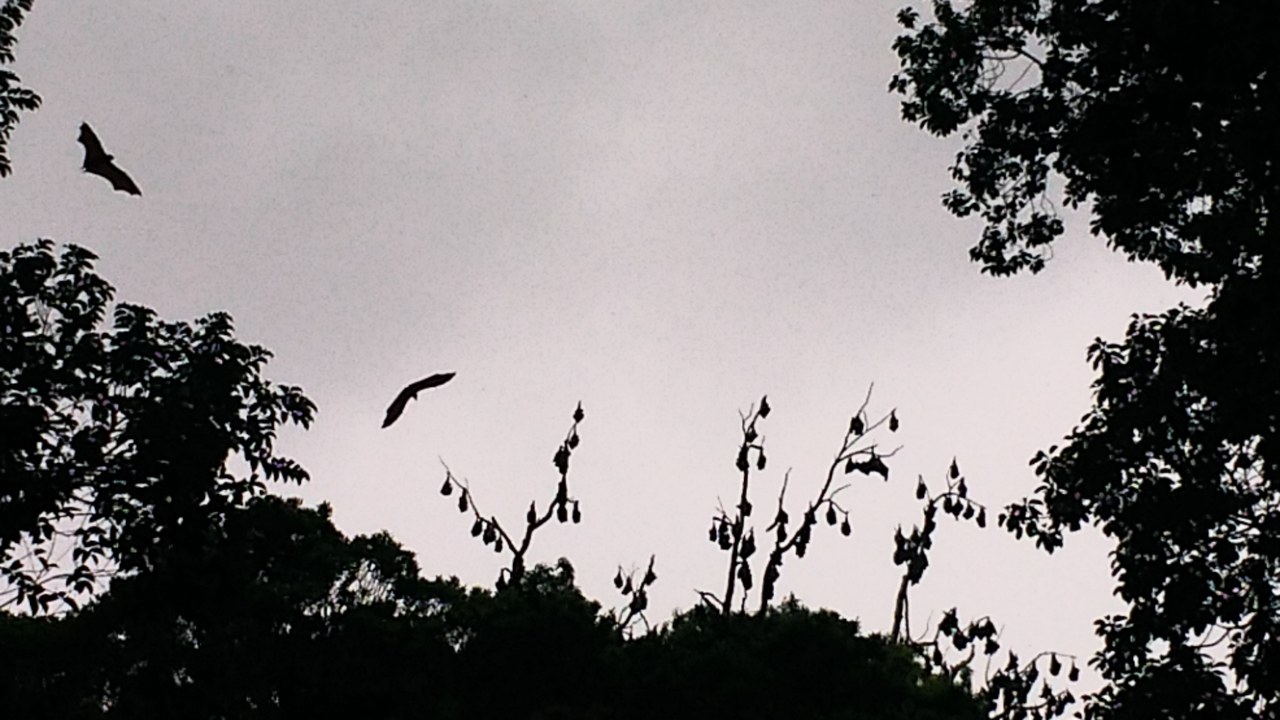
The clearest proof comes from the bats that never echolocate at all. Fruit bats and flying foxes — the largest bats in the world — navigate, find food and recognise landmarks primarily with vision and smell rather than sound. Some have exceptional vision, three times better than our own, according to the National Park Service, and some can see ultraviolet light. The Bat Conservation Trust notes that flying foxes have great night vision, and that nectar-feeding species can see in ultraviolet. If bats were blind, the fruit bats would be lost. Instead, they are the best-sighted bats of all.
Using echolocation in darkness no more proves blindness than using headlights at night proves a driver cannot see.
Why The Myth Survives
Part of the answer is the bats themselves. They fly very close to objects, which looks like bad eyesight — but the National Park Service reports that is a matter of curiosity more than poor vision. Part of it is the phrase: “blind as a bat” is so old and so rhythmic that it survives on sound alone, the way proverbs do. And part of it is that echolocation is simply more interesting to talk about than ordinary eyesight. A bat that sees with sound is a marvel. A bat that also sees with its eyes is just a mammal — and nobody repeats a saying about that.
The honest version is more interesting than the myth anyway. Vision varies by species and by task: a bat can have lower spatial acuity than a human in bright light while outperforming human vision at detecting light in darkness. Some species, including the brown long-eared bat, prefer hunting with both visual and sonar information — but when researchers gave them a choice in a 2003 study, visual input was preferred to sonar alone. In one set of measurements, echolocation was about twice as effective as vision for detecting insects in medium to low light — and the bats still kept using their eyes.
The Verdict
Bats are not blind. Every bat species can see, many see well, and the biggest bats in the world navigate by sight alone. Echolocation is not a replacement for eyes — it is an extra sense layered on top of them, the way a pilot uses both instruments and the window. The phrase got it exactly backwards: the animal famous for seeing with sound is also, quietly, seeing with its eyes all along.