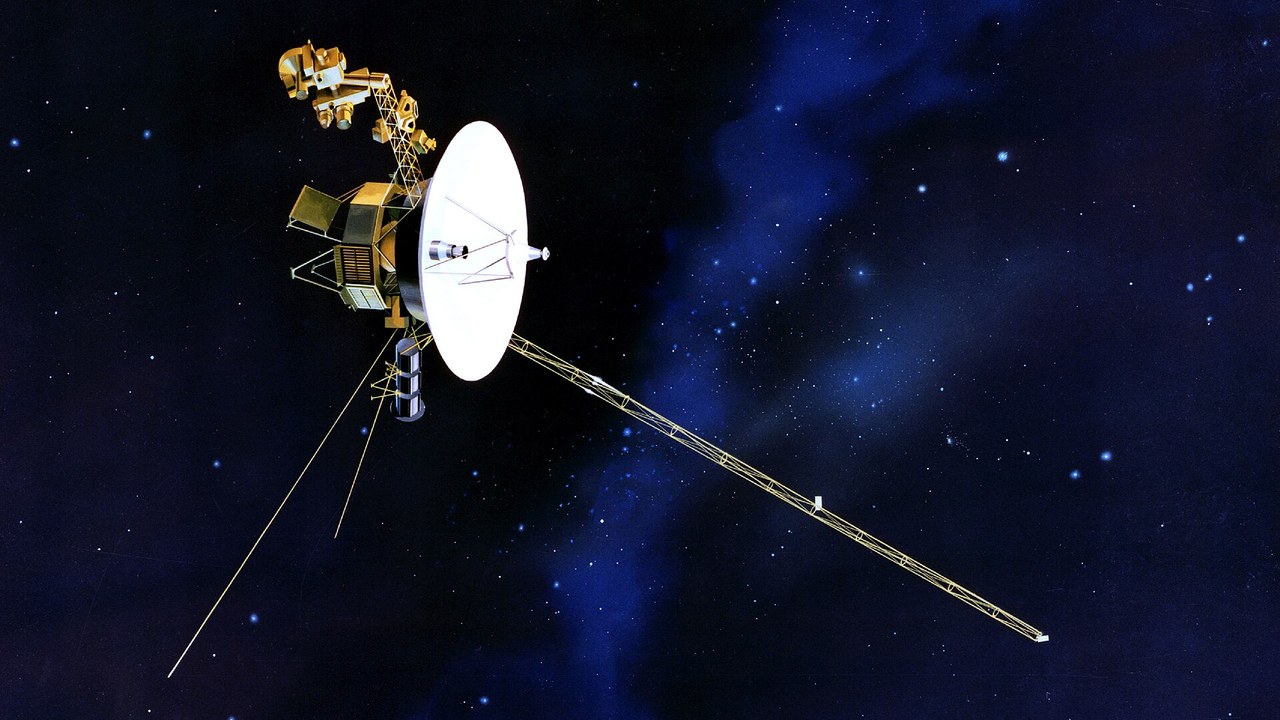
On Wednesday, November 18, 2026, at 5:16:07 a.m. EST, NASA’s Voyager 1 will become the first human-made object ever to sit one full light-day from Earth. The distance is 16,094,799,096 miles — 25,902,068,356 kilometres — the span light covers in 24 hours. From that moment, a radio command sent from Earth will take a full day to reach the spacecraft, and its reply will take another full day to come back. Every conversation with humanity’s farthest explorer becomes a two-day round trip.
Voyager 1 launched from Cape Canaveral on September 5, 1977, and it has taken 49 years, 2 months and 11 days to get this far. It whipped past Jupiter in 1979 and Saturn in 1980, then kept going, out past the planets, out past the edge of the Sun’s influence. In 2012 it crossed the heliopause — the boundary where the solar wind gives way to interstellar space — and it has been travelling through the space between the stars ever since, at about 38,000 miles per hour, heading toward the constellation Ophiuchus.
A Machine Older Than The Internet
What makes the milestone remarkable is not only the distance but the machine covering it. Voyager 1 runs on three onboard computers with about 68 kilobytes of memory between them — less than the cache of a single modern processor core — and a power supply that shrinks every year as its plutonium battery decays. NASA has been switching off instruments to keep it alive: the cosmic ray subsystem was turned off in 2025, and the low-energy charged particle instrument was switched off on April 17, 2026. Only two of its ten original science instruments still run: the magnetometer and the plasma wave subsystem.
The spacecraft lost contact for about 48 hours in October, a reminder of how fragile the link has become. Its signal, by early October, was already taking 23 hours, 52 minutes and 30 seconds to reach Earth. Engineers at NASA’s Jet Propulsion Laboratory expect the signal to grow too faint to hear sometime in the 2030s, and the thrusters that keep its dish pointed at Earth are another limit. For now, though, the 49-year-old probe still answers the phone — from a full day away.
How NASA Is Marking The Moment
NASA is inviting the public to mark the milestone. On Tuesday, November 17, after local sunset, people around the world are asked to join “Shine Bright for Voyager’s Light-Day” by creating a symbolic wave of golden light encircling the planet, flashing the letters “V-G-R” in Morse code with torches and phones. On Thursday, November 19, at 12 p.m. EST, NASA’s Jet Propulsion Laboratory in Southern California will host a moderated discussion with mission members and NASA leadership about the status of Voyager 1 and 2, the science the twin probes continue to gather, and the challenge of keeping them operating for so long.
Voyager 2, which launched first — on August 20, 1977 — but took the longer Grand Tour past Uranus and Neptune, trails its twin by about 3.2 billion kilometres and moves a little slower. It will not reach one light-day until around November 2035, and it may well fall silent before it gets there. Both spacecraft carry a Golden Record: a gold-plated disc with sounds, images and greetings from Earth, meant for anyone — or anything — that might one day find them. In about 40,000 years, Voyager 1 will pass within about 1.7 light-years of the star Gliese 445. Until then, it keeps going, one day farther from home at a time.
A radio signal leaving Earth now takes a full 24 hours to reach Voyager 1 — and its reply takes another 24 hours to come back.
THE STORY SO FAR
September 5, 1977 — Voyager 1 launches from Cape Canaveral, 16 days after its twin, Voyager 2.
1979–1980 — Voyager 1 flies past Jupiter, then Saturn, sending back the first close-up images of both worlds.
2012 — Voyager 1 crosses the heliopause and enters interstellar space, the first human-made object to do so.
Early October 2026 — the probe sits about 25.72 billion kilometres away, and its signal takes 23 hours, 52 minutes and 30 seconds to reach Earth. It loses contact for about 48 hours during the month.
November 10, 2026 — NASA announces the one-light-day milestone and the public events around it.
November 18, 2026 — at 5:16:07 a.m. EST, Voyager 1 reaches one light-day from Earth: 16,094,799,096 miles.
WHAT HAPPENS NEXT
Tuesday, November 17, after sunset — NASA’s “Shine Bright for Voyager’s Light-Day” event: people worldwide flash “V-G-R” in Morse code with torches and phones.
Wednesday, November 18, 5:16:07 a.m. EST — Voyager 1 crosses the one-light-day line, the first human-made object ever to do so.
Thursday, November 19, 12 p.m. EST — NASA’s Jet Propulsion Laboratory hosts a live discussion about the Voyager mission on NASA Live.
November 2035 — Voyager 2 is expected to reach one light-day, if it is still operating.