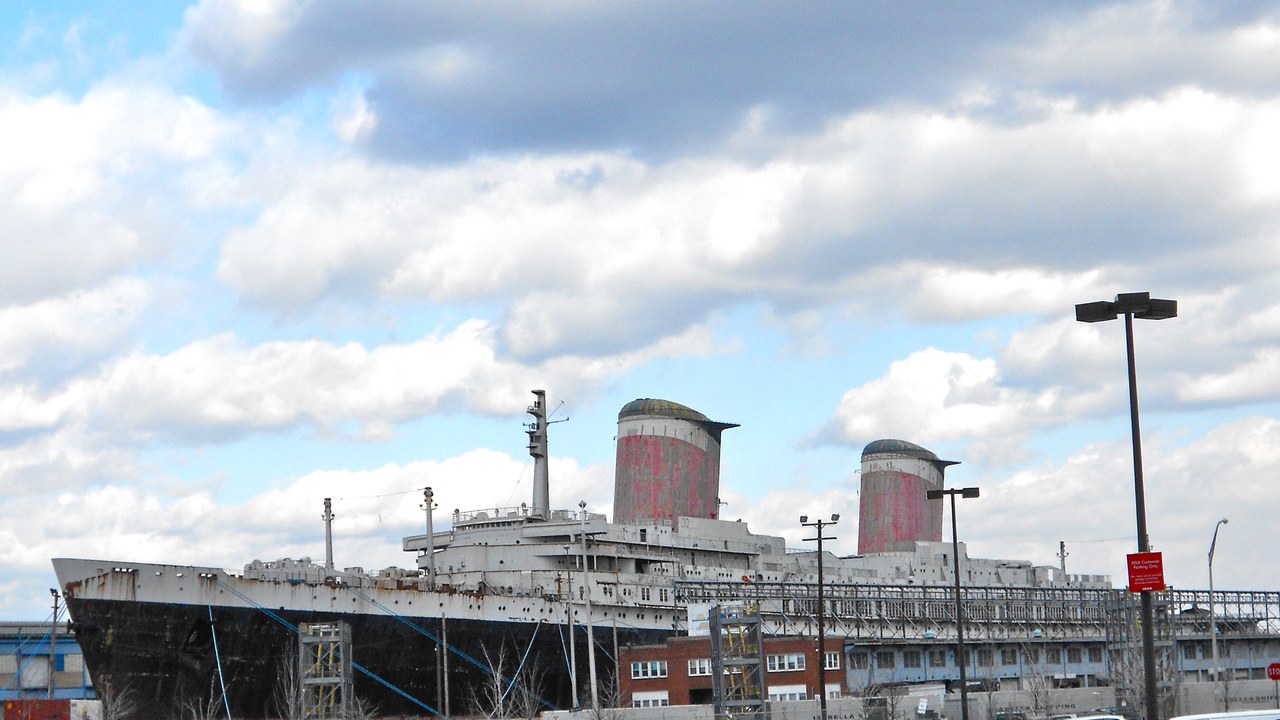
The fastest passenger liner in the world crossed the Atlantic Ocean in less than four days. On Wednesday, it sank in five hours. The SS United States, launched in 1951 and longer than the RMS Titanic, slipped beneath the Gulf of Mexico on the night of November 11, 2026, and became the world's largest artificial reef.
The ship settled onto the seafloor at 9:59 p.m. Eastern time, 7 hours and 19 minutes after crews began flooding it at about 2:40 p.m. Work crews opened valves connected to the ship's original seawater intake pipes and let the sea fill the hull — no explosives were used. The vessel was fully flooded and had started to sink by 5:47 p.m., county officials said. It now rests about 22 nautical miles southwest of Destin-Fort Walton Beach, Florida, in roughly 180 to 200 feet of water, with its upper decks about 60 feet below the surface.
A Sinking Moved Up A Day
The sinking was originally scheduled for Thursday, November 12. Okaloosa County officials moved it up by 24 hours on Monday night after heavy winds and unsafe weather were forecast for Thursday. The county bought the vessel in October 2024 for $10.1 million and moved it from Philadelphia, where it had been docked for nearly 30 years, to Mobile, Alabama, for environmental remediation. The ship left its longtime Philadelphia berth under tow on February 19, 2025. The full reef project cost $13.5 million.
Not everyone wanted the ship to go down. The SS United States Preservation Foundation went to federal court in Pensacola on November 3 seeking to halt the sinking; U.S. District Judge M. Casey Rodgers denied the emergency request on November 6. The SS United States Conservancy, meanwhile, preserved the ship's funnels and is developing an SS United States museum in Okaloosa County.
The Ship That Could Not Be Beaten
The SS United States was designed by William Francis Gibbs and launched on June 23, 1951, in Newport News, Virginia. At 990 feet long, it is the largest ocean liner ever built entirely in the United States — about 100 feet longer than the Titanic. On its maiden voyage in 1952 it set the transatlantic speed record, crossing in under four days, and that record still stands today.
It was built for more than speed. Gibbs designed the hull to be converted into a troopship in wartime, dividing it into 20 watertight compartments designed to keep it afloat with as many as five of them flooded. In service, the ship carried four presidents, the Mona Lisa, and a slate of 20th-century movie stars across the Atlantic in high-class style. Then the jet age arrived, the passengers vanished, and the great liner spent decades rusting at a Philadelphia pier, facing the scrap heap.
Thirty Years At The Pier
The long decay is part of the story. After its sailing days ended, the SS United States sat at Pier 82 in Philadelphia for nearly three decades, its red funnels fading, its hull rusting, its future argued over in courtrooms and council meetings. Preservationists fought to save it. Developers drew up plans that never happened. The scrap heap — the fate of almost every great liner — looked inevitable for years.
What saved it, in the end, was a county in Florida with a different idea. Okaloosa County, on the state's Panhandle, has sunk hundreds of artificial reefs over the years — ships and boats lowered to the seafloor to become habitat. The United States, nearly 1,000 feet long, becomes the centrepiece of that collection: a ship too big to scrap quietly, too famous to forget, and now too deep to ignore. The Conservancy's museum will keep the memory above water. The reef keeps the ship itself working — as habitat, as a dive site, and as the largest thing ever deliberately placed on the ocean floor.
What Happens On The Ocean Floor
The wreck opens a second life. Okaloosa County expects the reef to draw divers and anglers to the Florida Panhandle and to build habitat for tuna, marlin and swordfish. The ship will sit about a dozen nautical miles from the USS Oriskany, the former aircraft carrier sunk off Pensacola in 2006 — which means Northwest Florida will now hold the first and second largest artificial reefs on earth. Florida alone has created more than 4,000 artificial reefs since 1940, but none like this one.
Divers will not have to wait long: the wreck opens to divers the day after the sinking, according to local television reports, and eager scuba divers are already calling it a Mount Everest-type destination. The fastest ship ever built crossed the Atlantic in under four days. Its final voyage took seven hours — and its next chapter, on the ocean floor, is only just beginning. America's flagship is gone from the surface, but it is not gone.