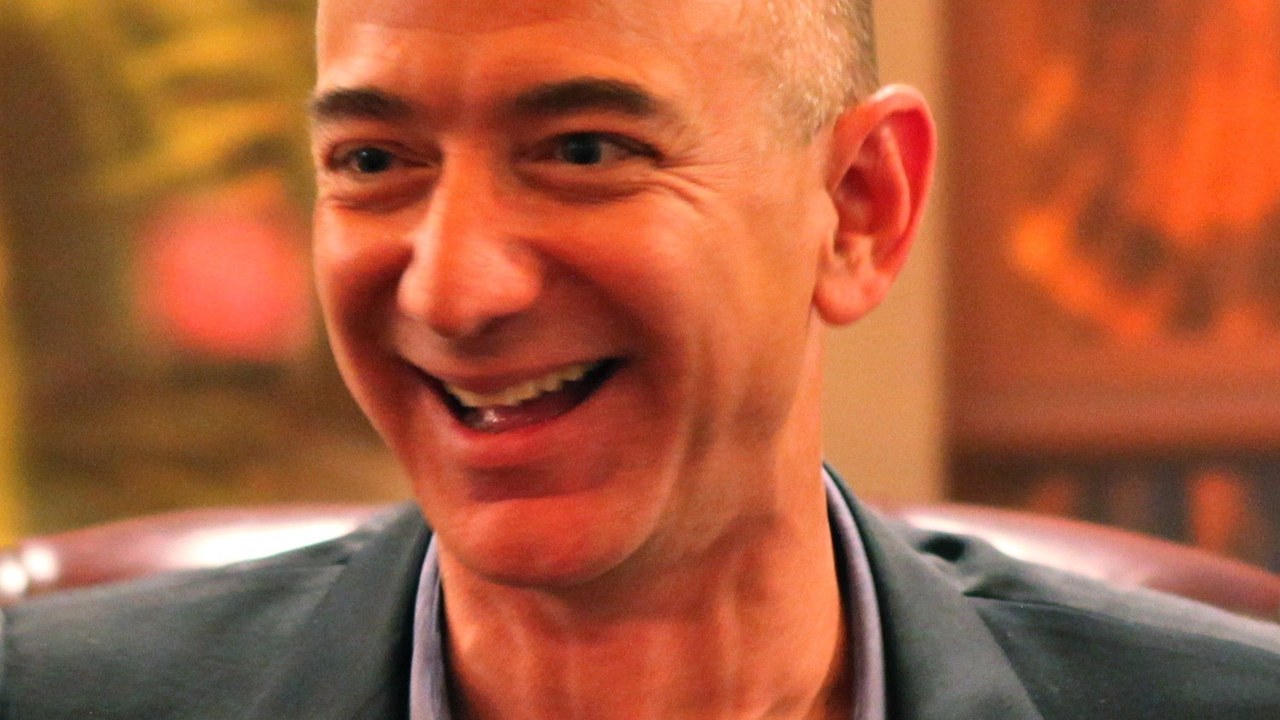
How much does Jeff Bezos earn per day? About $585 million — if you count from March to November 2026. His Amazon salary, meanwhile, is $224 a day. Both numbers are real, and the gap between them is the whole story: Bezos is not paid by Amazon. He is paid, on paper, by the rising value of the companies he owns — and in 2026, two private companies he barely talks about did most of the rising.
The maths is simple once you fix the dates. Forbes had Bezos at $224 billion on March 1, 2026, and at about $368.5 billion on November 3: a gain of $144.5 billion over 247 days, or $585 million a day. Change the window and the answer changes with it — which is why this article shows every window instead of hiding behind one.
THE KEY NUMBERS
The March-to-November average: $585 million a day (Forbes: $224 billion on March 1 to $368.5 billion on November 3, 2026 — +$144.5 billion in 247 days). The 12-month average: $375 million a day (Forbes 400, September 2026: $378 billion, up $137 billion in a year). The September surge alone: $3.4 billion a day (+$102 billion in 30 days, per TheStreet's October 8 report). The latest two weeks: about $631 million a day (Forbes: $368.5 billion on November 3 to $376.7 billion on November 16 — +$8.2 billion in 13 days). His actual Amazon salary: $81,840 a year — $224 a day — unchanged for decades, plus about $1.6 million a year for security, for total compensation of about $1,681,840 a year, or $4,608 a day. He has never received stock-based pay from Amazon.
WHERE THE $137 BILLION CAME FROM
The natural assumption is that Amazon's share price soared. It did not. The September jump came from two private companies getting their first real market prices. Blue Origin, the rocket company Bezos founded in 2000 and funded himself for 25 years, raised its first outside money in 2026 at about a $130 billion pre-money valuation, according to Forbes in July 2026, with Coatue expected to lead the round with $4 billion and Bezos adding $2 billion of his own. Before that round, Forbes had been carrying Blue Origin at a fraction of that value because there was no outside price to anchor to. The first outside price gave the stake a market value, and the fortune jumped.
The second revaluation was smaller but symbolic. Prometheus, an industrial-AI startup Bezos co-led, raised a $12 billion Series B in June 2026 at a $41 billion valuation, according to Axios. Forbes credits Bezos with about 20% of it — roughly $8.2 billion. It carried a message: the man written off as a space-and-retail figure was now a major holder in the AI buildout as well. Private valuations are not cash, though. If the next round prices lower, the value falls — and Bezos cannot sell his Blue Origin stake the way he sells Amazon shares.
THE AMAZON STAKE — AND WHAT HE GIVES AWAY
The foundation is still Amazon stock. The 2026 proxy statement lists Bezos as the beneficial owner of 950,434,581 shares — 8.8% of Amazon — as of late February 2026. He owned about 16% at the 1997 IPO; the 2019 divorce, which transferred about a quarter of his stake to MacKenzie Scott, and years of stock sales brought it down. He has sold more than $49 billion of Amazon stock since the IPO, according to Forbes, funding Blue Origin, the Washington Post purchase, the Earth Fund and the property portfolio.
The share count keeps falling. On November 12 and 13, 2026, Bezos donated 771,492 Amazon shares — about $198.9 million — to non-profits, according to SEC filings. After those transfers he retained 878.55 million shares, worth about $226.4 billion at Amazon's November 16 close of $257.75. His charitable stock donations in 2026 now total more than $629 million. Forbes estimated his net worth at $376.7 billion on the evening of November 16, the world's second-richest person behind Elon Musk. He and his wife, Lauren Sánchez Bezos — married in Venice on June 27, 2025 — had donated an estimated $4.7 billion to charitable causes by the end of 2025, including the $10 billion Bezos Earth Fund pledge from 2020.
THE STORY SO FAR
1964: Born January 12 in Albuquerque, New Mexico. 1986: Graduates from Princeton in electrical engineering and computer science. 1994: Founds Amazon in a Bellevue garage. 1997: Amazon goes public; Bezos owns about 16%. 2000: Founds Blue Origin. 2013: Buys the Washington Post for $250 million. 2019: Divorces MacKenzie Scott, transferring about a quarter of his Amazon stake. 2021: Steps down as Amazon CEO. March 1, 2026: Forbes' annual list puts him at $224 billion, fourth in the world. June 2026: Prometheus raises its Series B at a $41 billion valuation. July 2026: Blue Origin's first outside round prices at about $130 billion. August 1, 2026: Forbes has him at $278 billion. September 2026: The Forbes 400 prints $378 billion — up $137 billion in a year, the second-richest person in the world. October 10, 2026: Forbes' real-time tracker reads $380.8 billion. November 3, 2026: About $368.5 billion. November 12-13, 2026: Donates 771,492 shares. November 16, 2026: Forbes reads $376.7 billion.
WHAT HAPPENS NEXT
The next hard numbers arrive in early February 2027, when Amazon reports fourth-quarter results — the holiday quarter that decides whether the retail and cloud engines are still growing. The third quarter of 2026 set the bar: net sales of $201.9 billion, up 12%, and operating income of $28.1 billion. For the full 2025 fiscal year, Amazon did $716.9 billion in net sales, with operating income of $80.0 billion — and AWS produced $45.6 billion of that from $128.7 billion of sales. The cloud is the profit engine; the store is the revenue engine.
But the number that will move Bezos' fortune most is not an Amazon number. It is the next funding round for Blue Origin, and the next one for Prometheus. Both are priced by private investors, not by the market, so the fortune can jump $100 billion in a month on a single term sheet — or fall just as fast if the next round prices lower. Until then, the honest range is $368 billion to $381 billion, drawn from the dated Forbes prints of October and November 2026. And the salary stays $81,840 a year. At that rate, it would take Bezos about 7,100 years of salary to match one average day of his paper gains — which is why nobody should ever confuse the two numbers.