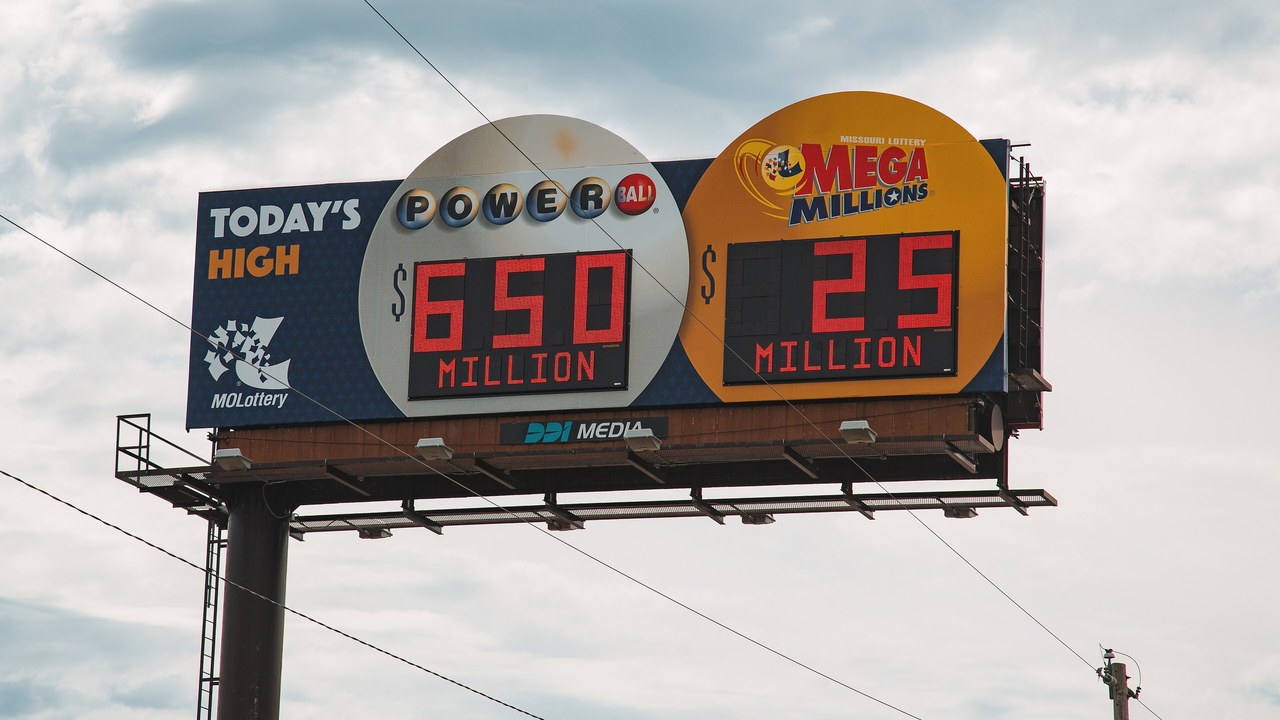
The biggest lottery jackpot in history, $2.04 billion, did not make its winner a billionaire. Edwin Castro's Powerball ticket, bought at Joe's Service Center in Altadena, California, ahead of the November 7, 2022 drawing, paid a lump sum of $997.6 million — already below the billion line before a single dollar of tax — and after federal taxes he kept an estimated $628.5 million. Between the billboard number and the bank number, about $1.4 billion quietly disappears. Here is the full board, and where the money goes.
Every jackpot on this list is advertised as an annuity: 30 payments spread over 29 years, each one 5% larger than the last, adding up to the headline figure. Almost every big winner instead takes the cash option — the actual prize pool, paid at once — which runs at roughly half the headline. Then taxes arrive: 24% is withheld up front, but a prize this size is taxed at the top federal rate of 37%, with state tax on top in most states. California is a famous exception — it does not tax its own lottery winnings at all.
THE KEY NUMBERS
No. 1 — $2.04 billion, Powerball, November 7, 2022, California. Cash value: $997.6 million, one winning ticket. After federal tax at 37%: an estimated $628.5 million kept — and $0 of California state tax.
No. 2 — $1.817 billion, Powerball, December 24, 2025, Arkansas. Cash value: $834.9 million, one ticket.
No. 3 — $1.787 billion, Powerball, September 6, 2025, Missouri and Texas. Cash value: $820.6 million, split between two tickets — about $410 million each before tax.
No. 4 — $1.765 billion, Powerball, October 11, 2023, California. Cash value: $774.1 million, one ticket.
No. 5 — $1.602 billion, Mega Millions, August 8, 2023, Florida. Cash value: $794.2 million — Mega Millions' biggest prize ever.
No. 6 — $1.586 billion, Powerball, January 13, 2016, California, Florida and Tennessee. Cash value: $983.5 million split three ways — the first billion-dollar jackpot in history.
The full club: 15 jackpots of $1 billion or more have been won since 2016. Not one of them put a billion dollars in a single winner's bank account after the cash option and taxes.
THE $2.04 BILLION, STEP BY STEP
Step one, the headline: $2.04 billion is the sum of 30 annuity payments across 29 years, not a pile of money that existed on draw night. Step two, the cash: the prize pool actually held $997.6 million, and Castro — like almost every major winner — took it all at once. Step three, the tax: the IRS withholds 24% immediately, but the final bill on a near-billion-dollar prize is figured at the 37% top rate. $997.6 million minus 37% federal tax is about $628.5 million — the figure tax professionals consistently estimate he kept, helped by California's refusal to tax its own lottery prizes. A winner in a high-tax state would have kept tens of millions less.
What happened next became its own story. The California Lottery named Castro the winner on February 14, 2023; he skipped the press conference. A man named Jose Rivera then sued, claiming the winning ticket had been stolen from him — a claim that was ultimately dismissed, leaving the money where the lottery had paid it. The record prize, in other words, survived its court case. What it could not survive was arithmetic.
WHY THE HEADLINE IS ALWAYS BIGGER THAN THE MONEY
The advertised number is big because big numbers sell tickets, and the system is built to produce them. Powerball lengthened its odds in 2015 and Mega Millions followed in 2017; at 1 in 292,201,338 and 1 in 302,575,350 respectively, jackpots now roll for months and feed on their own frenzy, which is why every prize on the modern record board dates from 2016 or later. The annuity headline also flatters the games: a $2.04 billion prize that costs the prize pool $997.6 million is a bargain for the billboard. None of this is hidden — it is printed in the games' own rules — but it is never printed as large as the jackpot.
THE STORY SO FAR
January 13, 2016: the first billion-dollar jackpot, a $1.586 billion Powerball shared by tickets in California, Florida and Tennessee. October 23, 2018: a $1.537 billion Mega Millions prize in South Carolina — cash value $877.8 million — won by a single ticket whose owner stayed anonymous. November 7, 2022: the $2.04 billion drawing is delayed overnight by a technical problem; one ticket, sold in Altadena, takes the record.
February 14, 2023: California names Edwin Castro. August and October 2023 add two more giants — $1.602 billion in Florida and $1.765 billion in California. In 2025 the board reshuffles again: $1.787 billion split between Missouri and Texas in September, then $1.817 billion in Arkansas on Christmas Eve. On August 12, 2026, a $1.04 billion Powerball in Illinois became the 15th billion-dollar jackpot — proof the club adds a member most years now.
WHAT HAPPENS NEXT
The record will fall; it is only a question of which winter. Every billion-dollar run begins the same way — months of rollovers, a prize pool fattened by the ticket-buying frenzy itself — and ends the same way: a cash value near half the headline and a federal tax bill near 37 cents on the dollar. When the next jackpot crosses $1 billion and the billboards light up, the honest questions are the three numbers this article is built on: the cash, the tax, and what the winner actually keeps. This board will be updated the day the record changes hands.
MORE MONEY STORIES AT MYTHPOST
For fortunes that really do clear a billion, see MythPost's net worth series — Elon Musk Net Worth 2026: From $1.45 Trillion To $874 Billion — Is He Still A Trillionaire?, Taylor Swift Net Worth 2026: $2 Billion — But Did Music Alone Really Make Her A Billionaire?, and Jensen Huang Net Worth 2026: What The Nvidia Founder Is Worth After Resigning.