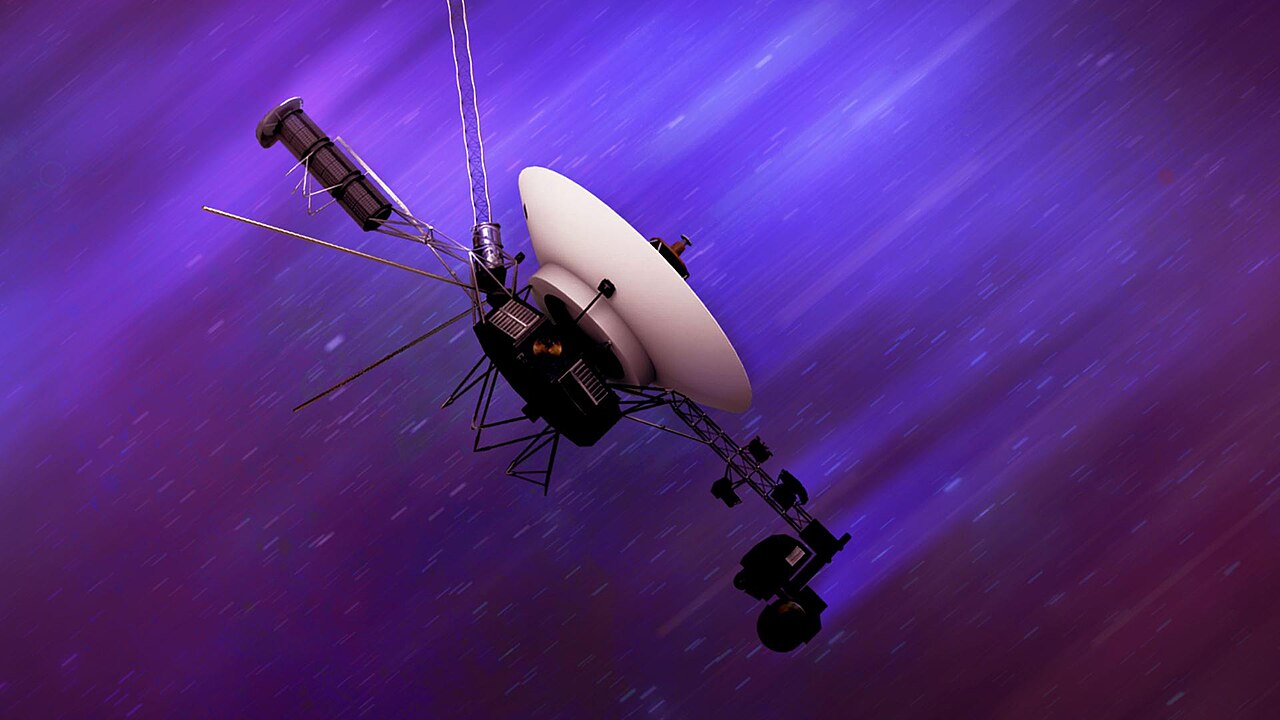
Voyager 1 is now one light-day from Earth. At 5:16 a.m. Eastern time today, Wednesday, November 18, 2026, NASA's 49-year-old spacecraft reached a distance of about 16.1 billion miles — so far away that a radio message sent from Earth now takes a full 24 hours to reach it, and the reply takes another full day to come back. No human-made object has ever been this far from home.
NASA announced the milestone this morning, calling it an extraordinary achievement for a spacecraft assembled by human hands and launched nearly 50 years ago. The distance is not a guess: it comes from the Jet Propulsion Laboratory's calculations of the probe's position, speed and trajectory. The confirmation signal — the probe's own message saying it is there — will not arrive until tomorrow, because even light itself needs a day to make the trip.
WHAT A LIGHT-DAY ACTUALLY MEANS
A light-day is the distance light travels in 24 hours: about 16 billion miles, or 25.9 billion kilometres. Light is the fastest thing in the universe, moving at nearly 300,000 kilometres per second, and it still needs an entire day to cross the gap between Earth and Voyager 1. When controllers at the Jet Propulsion Laboratory send the probe a command today, it arrives tomorrow. When Voyager 1 answers, the reply arrives the day after that. A single question and answer now takes two full days.
The crossing changes nothing on board. NASA is clear that a light-day is not a physical boundary, like the edge of the solar system: Voyager 1 felt no jolt and crossed no wall. The milestone is a measure of distance, and of endurance. It took a spacecraft built with 1977 technology nearly half a century to travel a distance that light covers in a single day. The spacecraft is still carrying the Golden Record, the gold-plated disc of greetings, music and pictures of Earth that it launched with, in case anyone ever finds it.
THE STORY SO FAR
September 5, 1977 — Voyager 1 launches from Cape Canaveral, Florida, sixteen days after its twin, Voyager 2, on a mission meant to last about five years and study Jupiter and Saturn.
1979–1980 — Voyager 1 flies past Jupiter, then Saturn, sending back the first close-up images of the giant planets, their moons and Saturn's rings.
February 14, 1990 — From about 3.7 billion miles away, Voyager 1 turns its camera back toward home and takes the ‘Pale Blue Dot’ photograph: Earth as a single pale speck in a band of sunlight.
February 17, 1998 — Voyager 1 passes Pioneer 10 and becomes the most distant human-made object in history — a title it has held ever since.
December 2004 — Voyager 1 crosses the termination shock, where the solar wind slows as it meets interstellar space.
August 25, 2012 — Voyager 1 crosses the heliopause and enters interstellar space, the region between the stars — the first spacecraft ever to do so.
October 18–19, 2026 — NASA's Deep Space Network fails to detect Voyager 1's signal during two scheduled sessions, 24 hours apart. Engineers trace the problem and restore contact, and an October 29 update says the probe is healthy.
November 17, 2026 — NASA invites people around the world to ‘Shine Bright for Voyager's Light-Day’, flashing golden light into the sky after sunset to mark the approaching milestone.
November 18, 2026, 5:16:07 a.m. ET — Voyager 1 reaches one light-day from Earth: about 16.1 billion miles, 25.9 billion kilometres, from home.
WHAT HAPPENS NEXT
Thursday, November 19, at noon Eastern, NASA holds a discussion at the Jet Propulsion Laboratory in Pasadena about the milestone, with mission leaders and scientists — and the probe's own confirming signal is expected to arrive around the same time, a day after the crossing. NASA has also said a new documentary about the Voyager mission is coming to its NASA+ streaming service. Beyond that, the mission's remaining years are a race against its own power supply: the plutonium generators that made about 470 watts at launch now make less than half that, and only two of the probe's original ten instruments — the magnetometer and the plasma wave detector — are still working. Recent power-saving measures could keep the spacecraft in contact for three to four more years, and NASA has forecast that one instrument could keep running into the 2030s. Voyager 2, meanwhile, will not reach one light-day until November 2035.
VOYAGER 1 BY THE NUMBERS
16.1 billion miles — Voyager 1's distance from Earth today, or 25.9 billion kilometres.
24 hours — how long a radio message now takes to reach the probe. The reply takes another 24 hours.
About 67,000 times — how much farther Voyager 1 is than the Moon, which sits 238,855 miles away.
About 173 times — how much farther it is than the Sun, 93 million miles away.
8 minutes — how long sunlight takes to reach Earth. Voyager 1 is a full light-day out.
38,000 mph — Voyager 1's speed relative to the Sun, about 61,000 km/h.
49 years, 2 months and 13 days — how long the spacecraft has been travelling.
40,000 years — roughly how long until Voyager 1 passes within 1.7 light-years of the star Gliese 445.
2 of 10 — the instruments still working, from the ten the spacecraft launched with.
“When I was first working on Voyager back in 1977, I never expected Voyager 1 to reach one light-day,” said Linda Spilker, the mission's project scientist at NASA's Jet Propulsion Laboratory.